
Myths & Realities
- Home
- Overview of Plastics
Myth:
Reusing plastic water bottles can cause them to break down into carcinogenic compounds.
“Many are unaware of poisoning caused by re-using plastic bottles. Some of you may be in the habit of using and re-using your disposable mineral water bottles (eg. Evian, Aqua, Ice Mountain, Vita, etc), keeping them in your car or at work. Not a good idea. In a nutshell, the plastic (called polyethylene terephthalate or PET) used in these bottles contains a potentially carcinogenic element (something called diethylhydroxylamine or DEHA). The bottles are safe for one-time use only; if you must keep them longer, it should be or no more than a few days, a week max, and keep them away from heat as well.
Repeated washing and rinsing can cause the plastic to break down and the carcinogens (cancer-causing chemical agents) can leach into the water that YOU are drinking. Better to invest in water bottles that are really meant for multiple uses. This is not something we should be scrimping on. Those of you with family – to please advise them, especially children.”
Reality:
False
This bit of plastic bottle scare lore is based upon a master’s thesis from a University of Idaho graduate student, one which was unfortunately reported upon by the media despite its lack of peer review. According to The International
Bottled Water Association (IBWA):
The US Food and Drug Administration (FDA) regulates bottled water as a packaged food product and, for bottled water and all other foods and their packaging, FDA has determined that PET meets standards for food contact materials.
The basis for [the e-mail was] a college student’s masters thesis that was not subject to peer review and did not reflect a level of scientific rigor that would provide accurate and reliable information about the safety of these products. Fortunately, FDA requires a much higher standard to make decisions about food contact packaging. DEHA, as mentioned in the email is neither regulated nor classified as a human carcinogen. Further, DEHA is not inherent in PET plastic as raw material, byproduct or decomposition product. DEHA has been cleared by FDA for food contact applications and would not pose a health risk even if present. DEHA is a common plasticizer used in many plastic items, many of which are found in the lab setting. For
this reason, the student’s detection (see comment above) is likely to have been the result of inadvertent lab contamination.
Also note that PET plastics used for bottled water containers are not unique to this product type and is the same as PET plastics used to package other common foods and beverages.
(No “diethylhexyl adipate” (DEHA) is used in PET manufacturing. For details pl. refer Pl. refer FAQ of this note.)
The Environmental Protection Agency (EPA) at one time included DEHA on the list of toxic chemicals maintained under the federal Emergency Planning and Community Right-to-Know Act (EPCRA), but they have since removed it from the list because DEHA “cannot reasonably be anticipated to cause cancer, teratogenic effects, immunotoxicity, neurotoxicity, gene mutations, liver, kidney, reproductive, or developmental toxicity or other serious or irreversible chronic health effects.” And, according to the International Agency for Research on Cancer (IARC), diethylhexyl adipate “is not classifiable as to its carcinogenicity to humans.”
Some organizations (including the IBWA) do recommend that plastic water bottles be used only once before recycling, but not because re-use is likely to cause carcinogenic compounds to leach from the plastic bottles into the liquids they hold. The concern is that people (particularly children) can too easily spread and ingest bacteria from their hands and mouths by re-using bottles without properly washing them or allowing them sufficient time to dry.
Frequently Asked Questions (FAQ) on PET
Will a plastic bottle leach harmful substances into water if I reuse it?
Most convenience-size beverage bottles sold in the U.S. are made from polyethylene terephthalate (PET). The FDA has determined that PET meets standards for food-contact materials established by federal regulations and therefore permits the use of PET in food and beverage packaging for both single use and repeated use. FDA has evaluated test data that simulate long-term storage and that support repeated use.
The toxicological properties of PET and any compounds that might migrate under test conditions have also been well studied. The results of these tests demonstrate that PET is safe for its intended uses. (For details, see The Safety of Polyethylene Terephthalate.)
What about the student project that claimed to have found unhealthy compounds in water samples from reused bottles?
The subject of a widely circulated e-mail hoax, these claims stem from a University of Idaho student’s masters thesis that was promoted in the media but was not subject to peer review, FDA review or published in a scientific or technical journal.
While the student project may have been suitable work for a masters thesis, it did not reflect a level of scientific rigor that would provide accurate and reliable information about the safety of these products. Fortunately for consumers, FDA requires a much higher standard to make decisions about the safety of food contact packaging.
But I read that the student’s project found carcinogens?
The student’s thesis incorrectly identifies di(2-ethylhexyl) adipate (DEHA), a plastics additive, as a human carcinogen. DEHA is neither regulated nor classified as a human carcinogen by the U.S. Occupational Safety & Health Administration, the National Toxicology Program or the International Agency for Research on
Cancer, the leading authorities on carcinogenic substances.
In 1991, on the basis of very limited data, the U.S. Environmental Protection Agency classified DEHA as a “possible human carcinogen.” However, in 1995, EPA again evaluated the science and concluded that “…overall, the evidence is too limited to establish that DEHA is likely to cause cancer.”
Further, DEHA is not inherent in PET as a raw material, byproduct or decomposition product. DEHA is a common plasticizer that is used in innumerable plastic items, many of which are found in the laboratory. For this reason, the student’s detection of DEHA is likely to have been the result of inadvertent lab contamination. This is supported by the fact that DEHA was detected infrequently (approximately 6% of the samples) and randomly, meaning that the frequency of detection bore no relationship to the test conditions.
Moreover, DEHA has been cleared by FDA for food-contact applications and would not pose a health risk even if it were present.
Finally, in June 2003, the Swiss Federal Laboratories for Materials Testing and Research conducted a scientific study of migration in new and reused plastic water bottles from three countries. The Swiss study did not find DEHA at concentrations significantly above the background levels detected in distilled water, indicating
DEHA was unlikely to have migrated from the bottles. The study concluded that the levels of DEHA were distinctly below the World Health Organization guidelines for safe drinking water.
Is it true that the U.S. Food and Drug Administration (FDA) only allows plastic beverage bottles, such as those made with polyethylene terephthalate (PET), for one-time use?
No, FDA allows PET to be used in food-contact applications, including food and beverage packaging, regardless of whether the packaging is intended for single or repeated use. PET beverage bottles sold in the United States are designed for single use for economic and cultural reasons, not because of any safety concerns with PET.
In fact, refillable bottles made with the same PET resin as single-use bottles are safely reused in a number of other countries. The only difference is that refillable bottles have thicker sidewalls to enable them to withstand the mechanical forces involved with industrial collection and commercial cleaning and refilling operations.
Can freezing a PET beverage bottle cause dioxins to leach into its contents?
his is the subject of another e-mail hoax. There simply is no scientific basis to support the claim that PET bottles will release dioxin when frozen. Dioxins are a family of chemical compounds that are produced by combustion at extremely high temperatures. They can only be formed at temperatures well above 700 degrees
Fahrenheit; they cannot be formed at room temperature or in freezing temperatures. Moreover, there is no reasonable scientific basis for expecting dioxins to be present in plastic food or beverage containers in the first place.
Compiled by :
PET Marketing Technical Services
Phone: 022 –3032 22012 / 2251 / 2252
Source: http://www.plasticsinfo.org/beveragebottles/faq.html
POINT: Plastics / plastic bags are harmful to plants & the soil
Counter Point:
- Plastics protect plant life in multiple ways
- Plastics prevent massive deforestation by offering wood substitutes. eg. Furniture, building materials, crates
- Plastic pipes are used extensively in Irrigation & Water Management
- Flood Irrigation, Sprinkler Irrigation, Micro Irrigation (Drip/Trickle) etc
China uses One million tonnes of PE in agricultural application.
POINT: Plastics are not recyclable
Counter Point: Plastics are 100% recyclable via various routes :
- Mechanical recycling : Plastics can be recycled several times into economically useful low cost products eg. Footwear, mats, sewer pipes etc.,
- Waste plastics are also recycled without sorting into synthetic lumber / wood products like rails, fencings, posts, benches and land scaping products.
- Plastics can be thermally recycled / incinerated to recover energy
- Plastics can be chemically recycled to recover monomer for reuse.
In India we already recycle 60% of plastics from both Industry and urban waste streams Vs world average of 20-25%.
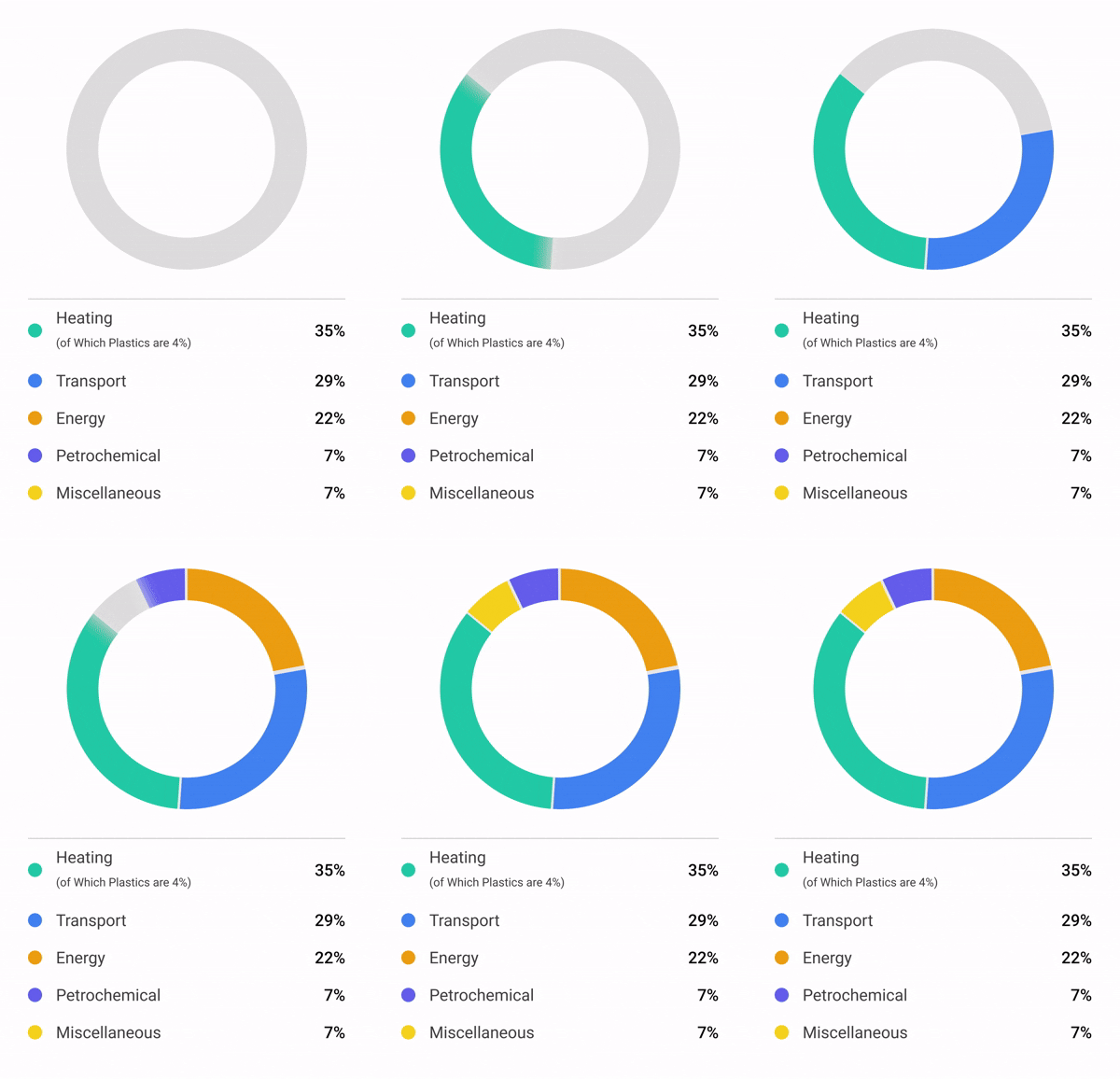
POINT: Plastics deplete precious & scarce fossil fuel
POINT: Plastics are toxic and are not safe for usage
Counter Point: Plastics are used worldover safely for personal care products, packaging of food & medicine, in-vitro medical applications and for child care products.
- Toothbrush, toothpaste tubes, shampoo bottle
- Milk pouch, edible oil container, ice cream pack
- Blister packing – tablets and capsules
- Medical disposables – IV bags, blood bags, gloves
- Heart valve, hip joint
- Toys, diapers
Food and drugs authorities worldwide permit use of different plastics in various applications. Industry needs to adhere to prescribed standards.
POINT: Plastic bags contain plasticizers
Counter Point:
- Plastic bags are made from Polyethylene (PE) which is a polymer of pure Carbon & Hydrogen. The material by itself is soft in nature. No plasticizers are used / required for any Polyethylene application including Poly Bags.
- The campaign that Plastic bags contain plasticizers is a malicious canard
- Plasticizers are used only in PVC Products.
POINT: Plastic bags contain titanium dioxide and lead based components which are toxic & Dyes used in coloured bags cause severe health hazards.
Counter Point:
- Most of the pigments used for making bags are organic in nature. Use of lead or cadmium based compounds does not arise at all.
- The inorganic pigments used in plastics do not contain lead or cadmium.
- Organic pigments which are used are compatable with the polymer to get bonded. They cannot leach out.
Industry has accepted to use natural unpigmented carry bags for food contact applications. Recycled bags will be coloured (using BIS approved pigments) for other applications.
POINT: Cadmium used in plastic bags is bioaccumulative & toxic; Plastics contain 54 potential carciogens or cancer causing agents
Counter Point:
- The additives used in plastic bags are mainly antioxidants. There is no cadmium in either polyethylene or additives.
- Plastic do not contain cadmium and they are not bioaccumulative.
- Plastic bags do not produce any obnoxious or toxic fumes as such or upon burning.
- There are no single plastics formulations / compounds / applications which contain 54 ingredients or components.
Misinformation campaign misleads the public.
POINT: Plastic disposal by burning causes CO poisoning, endocrinal damage, hormone disruption, multiple cancer and affect human fertility
Counter Point: The different uses of commercially produced oil.
- Burning of Polyethylene does not cause endocrinal damage, hormone disruption, multiple cancer and human fertility
- 4 Plastics are even used in controlled release of drugs for in vivo (oral) formulations.
Misinformation campaign misleads the public.
POINT: ü Causes of acid rain
Counter Point:
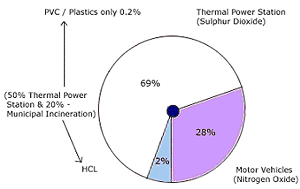
Acid rain – plastics : not the culprit at all.
POINT: Plastic bags contaminate water
Counter Point:
- Polyethylene pouches (same material as plastic bags) are used to pack/serve drinking water.
- Plastic bottles are globally used to pack mineral water for health and hygenic reasons.
- Plastics are used extensively for domestic and industrial water filters – housings, membranes, plates and candles, etc.
- Issue is not contamination but misuse.
We do not recommend throwing of plastic bags into the water. The bags should be collected for recycling.
POINT: Plastic are not biodegradable - hence threat to environment
Counter Point:
- Other materials like metal and glass are also not biodegradable
- Composite containers like plastic coated paper cups, tetra packs & bricks also do not biodegrade easily (additional penalty – not recyclable / harmful leachates)
- Biodegradation in buried land fills is a very slow process (more than 15 years)
– Anaerobic conditions / methanogenic bacteria
– Newspaper / telephone directories found in landfills even after 40 years.
– Perishable product like waste food, raked leaves and lumber found in landfill even after 25 years.
Misinformation campaign misleads the public.
POINT: Plastic are not biodegradable - hence threat to environment
Counter Point: Plastics are 100% recyclable via various routes :
- Industry has already undertaken R & D on bio-degradeable applications (eg. Starch Based Mulching films) in specified areas.
Bio degradation is not economically viable for most applications. Solution lies in reuse & recycling into extended life cycle products.
POINT: Plastic wastes are eco-hazardous
Counter Point:
- Plastics are crushable and highly compactible; they occupy less space in land fills.
- Plastic wastes are predominantly eco-neutral (no leachates to contaminate soil / ground water.
- Plastic wastes contribute to increasing calorific value of municipal solid waste for incineration (useful source of energy 8-9 GJ/T 20 GJ/T (in W.E. plastic wastes provide 30% of energy generated in MSW recovery plants).
- Plastic films & sheets are used for protective lining of hazardous/chemical landfills to protect surrounding soil & ground water from serious contamination. Misinformation campaign misleads the public.
Plastics have become important material of construction in environmental engineering.
POINT: Paper & cloth bags are better alternatives than plastic bags
Counter Point:
- If plastic bags / packaging is replaced with traditional materials like paper, cloth, jute, metal, etc., it would lead to a major penalty on the economic system
- 4 Phenomenal increase would be affected in increase of
- Weight of packaging
~300% - Volume of waste ~160%
- Energy Requirement
~110% - Cost of Packaging ~210%
Hence, there are no eco-viable alternatives to plastics in modern society
- Weight of packaging
POINT: Paper & cloth bags are better alternatives than plastic bags
Counter Point:
- Paper is not eco-friendly
We need to remind ourselves that making of paper and products consumes a lot of chemicals and requires a large amount of water and effluent problems are severe. Besides paper, unless coated with polymeric materials (or wax), cannot withstand wet conditions which are widely prevalent in India, particularly during monsoon periods. Paper making also consumes a lot of energy. In the Indian context the most serious problem is the availability of pulp. Environmental degradation has unquestionably occurred due to pulp manufacturing activities as commercial forestry, on large scale, is still a taboo. Padmabhushan Prof. M. M. Sharma (FRS)
Padmabhushan Prof. M. M. Sharma (FRS).
POINT: Paper and cloth bags are better alternatives than plastic bags
Counter Point:
- Globally 5th Largest Consumer of Energy
– 10% of All Industry Energy Consumption
– 4% of World Energy Consumption - One of the Largest Users of Water ü 1 Mt of Paper (7000 – 8000 copies of News paper) 10 to 17 trees needed and Paper cannot be recycled indefinitely; Maximum 4 Times.
- Recycling is also energy intensive and requires chemicals for bleaching / deinking.
- Rated Medium in Biodegradability with Associated Hazards like leachates.
Paper imposes heavy burden on environment. If we do not ban paper, why ban plastics?
Source : The World Resources Foundation, UK
POINT: Paper & cloth bags are better alternatives than plastic bags
Counter Point: Plastics are 100% recyclable via various routes :
- The smaller volume of plastic bags can help conserve landfill space.
- Nothing degrades fast enough to extend the useful lives of modern US landfills… not paper, not plastics, nothing.
- 30 percent less material is used to produce today’s plastic bags than the bags made just 5 years ago.
- Compared to paper grocery bags, plastic grocery bags :
– Consume 40 percent less energy than paper (1.34 million MJ Vs 0.58 million MJ for 1 million bags)
– Generate 80 percent less solid waste
– Produce 70 percent fewer atomospheric emissions
– Release upto 94 percent fewer waterborne wastes.
Source : Dr. William Rathje, University of Arizona Garbage Project, usa/German federal office.
POINT: Paper & cloth bags are better alternatives than plastic bags
Counter Point: How eco-friendly is cotton ?
- Growing Cotton:
– One of the Most Chemical intensive Crops
– Contaminates Intensive use of Soil Fertilizersand Pesticides - Processing Cotton:
Bleaching – Contaminated Effluents Dyeing – Synthetic dyes not biodegradable, Biodiabolic Mercerising – 40% remains as waste Anti-felt Finishing – Heavy metals cr, cu, cd. Water proofing – Enters the food chain Silk weighing – Released by clothing when worn 4 Auxiliary Agents – Absorbed by skin 4 Washing for reuse – Detergents, Solvents
When you wear cotton, you also wear Toxins
Source : Statesman
POINT: Paper & cloth bags are better alternatives than plastic bags
Counter Point:
|
Jute processing has adverse impact on environment
POINT: Plastics deplete resources
Counter Point: Plastics Conserve Resources
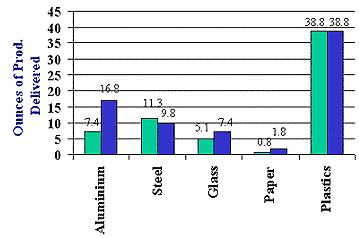
Plastic – the most resource efficient packaging material : highest product – package ratio.
Source : Dr. William Rathje (SPI/APC).
POINT: Plastics deplete resources
To pack 500 grams of coffee:
| Packing Material | Weight |
|---|---|
| Glass | 500 gms |
| Tin | 130 gms |
| Plastic | 12 gms |
POINT: Plastics are major source of solid waste problem.
Counter Point: In developed economies with disposable lifestyle (eg. W. Europe) plastics contribute small amount to solid wastes
- Total Solid Waste : 2.8 Billion Tons
- Plastic Wastes : 16 Million Tons
- % to Total Solid Waste : 0.6 %
- 4 Municipal Solid Waste : 137 Million Tons
- Plastic in MSW : 11 Million Tons
- % to Total MSW : 8 %
Source : Dr. William Rathje, University of Arizona Garbage Project, usa/German federal office.
POINT: Plastics are major source of solid waste problem.
Counter Point:
Municipal Solid Waste Composition
W. Europe
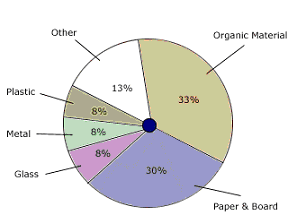
In developed economies with disposable lifestyle, plastics contribute only 8% by weight to Municipal Solid Waste (MSW). The rest consists of organic matter, paper, wood, metal, glass etc.
POINT: Plastics are major source of solid waste problem.
Counter Point:
Municipal Solid Waste Composition
W. Europe
In developed economies with disposable lifestyle, plastics contribute only 8% by weight to Municipal Solid Waste (MSW). The rest consists of organic matter, paper, wood, metal, glass etc.
Counter Point: Plastics Conserve Resources

Plastic – the most resource efficient packaging material : highest product – package ratio.
Source : Dr. William Rathje (SPI/APC).
POINT: Ragpickers find thin gauge plastic bags unviable to collect causing problems in disposal.
Counter Point:
- Along with Ministry of Environment & Forests (MOEF) industry has taken initiative on the following :
– Increase the thickness of virgin carry bags to minimum thickness of 20 microns (vs 5 microns at present)
– Increase the thickness of recycled carry bags to minimum thickness of 25 microns - Increased thickness / weight will provide adequate economic incentives to ragpickers to pickup waste bags & channel them into the recycling chain which is well established
Plastic bags are already recycled into useful products like barsati films and mats.
POINT: Plastics bags have no reuse
Counter Point: The thick gauge bags are retained by consumers for multiple secondary usage over extended period of time.
- Thereafter they are collected and recycled into very useful products like the barsati film, nursery bags, etc.
For very thin bags, industry has already accepted increasing the minimum thickness to make reuse and recycling viable.
POINT: Plastic bags are manufactured by 10,000 unregistered units
Counter Point:
- The number of jhabla bag manufacturing units have been highly exaggerated.
– In Maharashtra, registered and unregistered units total 1000.
– Maharashtra is a major centre accounting for almost 40 % of entire production.
– On all India basis, this number does not exceed 2500 units. - Many of these units also produce other useful products from Polyethylene films.
- The total number of plastic processing units (all types) in the country is only 13,000
Plastic processing units play a vital role in national economy beside major contributions to the exchequer.
POINT: Plastic bags are produced in most unsanitary conditions.
Counter Point:
- Virgin plastic bags are manufactured by high quality organised units whose quality products are also exported to developed countries like Germany & USA.
- Recycled jhabla bag manufacturers are in tiny, cottage, small & unorganised sector
- There is a need for Govt./MOEF/local authorities to provide adequate infrastructure like recyling zone & parks with common effluent treatment facilities
- Industry is committed to upgrade technology for better products & working conditions through ICPE
- 4 Industry is willing to work with local authorities in setting up central recycling plants / parks.
Let us support industry & enterprise. Let us not kill it by misconceived ideas
POINT: Plastic bags choke drains in monsoon resulting in floods
Counter Point:
- The root cause is dumping of all types of waste by public into open sewers & drains.
- Plastic bags form a miniscule % of the dumped waste. Other objects like waste tyres & rubber products, discarded footwear, metal cans, bricks, mortar and garbage have been found dumped in drains & sewers leading to chokage.
The solution lies in proper waste management & timely cleaning of sewers & drains before monsoons.
POINT: Plastic bags choke drains in monsoon resulting in floods
Counter Point:
Ultra-thin carry bags are exported from India to Germany / other countries but these are not found littered on streets due to good civic sense and supportive waste management systems.
Most countries have adopted two bin culture – segregating dry and wet garbage.
Plastics industry in India has been pleading with local governments for proper segregation systems and provision of bins.
This will help avoid littering and ensure recycling of waste plastics.
Industry has already donated plastic bins in cities like Delhi and Calcutta.
ICPE along with government is committed to launch public education campaigns to enhance civic sense.
Government should consider harsh penalties and deterrents for littering.
Infrastructure and system support is a must for proper waste management. Remember, plastic do not litter but people do.
POINT: Industry has not taken any initiative on recycling and waste management.
Counter Point:
Conducted national and state level seminars / workshops and meets with public, NGOs, Government Departments, local authorities. Industry is committed to continuing education, awareness and multimedia communication program
Industry has already formed Indian Centre for Plastic in the Environment (ICPE), an autonomous national body registered under Societies Act, with a seed capital Rs. 2 Crores on recommendation of a Task Force constituted by the Ministry of Environment and Forest (MOEF) to handle all issues related to Plastics and Environment in the Country.
ICPE helps sustain an environment friendly image of plastics by highlighting the positive role of plastics in conserving resources and its 100 % recyclability
Plastic industry is a responsible care industry.
Objectives of ICPE
- Developing technologies
- Applications development
- Waste Management
- Database and information system
- Education & Promotion
- Testing & standards
- Life cycle analysis
The Common Agenda
The plastic industry is a Responsible Care Industry. Over the years it has taken a number of eco-initiatives in addressing environmental and socio-economic issues …
however much more needs to be done.
Industry and media need to work together in a collaborative spirit to bring about proper appreciation and positioning of the unique contribution of plastics to environment and modern society.
Industry welcomes objective, unbiased public debate as an important input to further improve its efforts in serving society and in protecting the environment. We have a shared vision and a common destiny.
Let us call a halt to the sustained misplaced anti-plastics campaign and work together for a better future.