Life Cycle Analysis

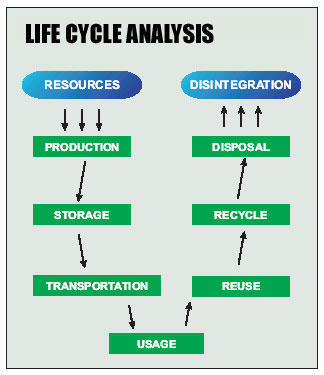
Life Cycle Analysis is an important environmental management tool to gauge the impact of a product on the environment from its manufacturing stage to its final disposal / disintegration.

The development of industries and the various man – made activities to fulfil the requirement of human race, has created an enormous impact on the environment. Any man-made product has some impact on the environment. To analyse the impact/effect of a particular product on he environment, one has to consider the life cycle analysis of the product which consists of the following aspects :

Life cycle analysis on following Plastics materials/proudts have been included in this document :

1) LCA of PP-HDPE Woven sacks vis-à-vis jute/paper
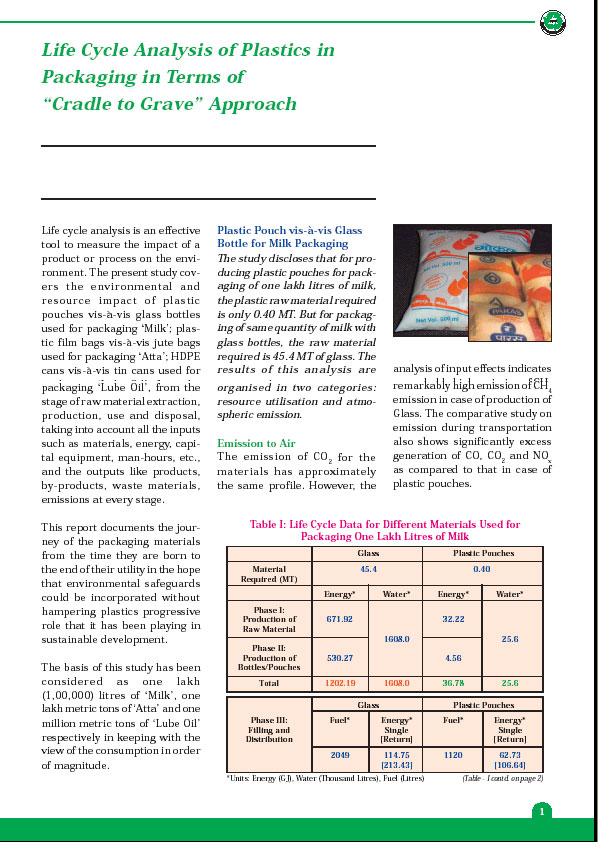
2) LCA of Plastics in Packaging

For – Milk
       – Atta(Flour) 
       – Lube Oil

Packaging is both a symbol of society’s consumption habits and reflection of its progress. The user expects it to have better strength, easier handling, to be lighter, more aesthetic, safer from a hygiene point of view, etc. The manufacturer undertakes research and development to meet these demands and to offer a high quality product. In addition to its standard attributes, today’s packaging just also contribute to protecting the environment, and certainly must not damage it besides being friendly to human health. The packaging referred to in this document is used to pack and distribute bulk products, like cement, fertilizers, sugar, food grains, salt, chemicals, oilseeds etc. as opposed to the carry bags that vendors offer their customers for carrying various edible/non-edible items purchased in retail.

Today where there is a lot of controversy about different packaging materials and their environmental credentials, an ecological assessment as well as study of effects on human health is necessary. In view of this ICPE (Indian Centre for Plastic in the Environment, New Delhi) decided to carry out a Life Cycle Analysis (LCA) of bulk packaging materials (Jute Sacks, PP-HDPE woven Sacks and Paper Sacks) with a capacity of 50 kg or below. Life cycle analysis is an effective tool to measure the impact of a product or process on the environment. In this study, it covers the environmental and resource impact of PP-HDPE woven sacks in particular vis-à-vis Jute/Paper from the stage of raw material extraction, production, use and disposal, taking into account all the inputs such as materials, energy, capital equipment, man-hours, etc.) and the outputs like products, by-products, waste materials, emissions at every stage using “cradle to grave” approach.

Resource Consumption & Recovery

The analysis by steps identifies the production of jute and paper and subsequently manufacture of sacks as being responsible for the greatest consumption of energy (~669.6 Thousand GJ/MMT of packed product) in case of paper bag and 333 Thousand GJ/MMT in case of jute sacks, as compared to PP-HDPE woven sacks (~226.8 Thousand GJ/MMT). Energy consumption related to transportation of bulk goods shows that jute sack transport requires significantly more energy — about 2036 GJ/MMT — and paper packaging about 928 GJ/MMT, compared to PP-HDPE woven sacks.

Read More

Another major resource utilization is in terms of water. Jute sack production uses approximately 22 Thousand lakh litres per MMT, and paper about 18 Thousand lakh litres per MMT — nearly 10 times (jute) and 7 times (paper) more than PP-HDPE woven sacks.

Chemical usage is another concern: 258 tons/MMT for jute and 4647 tons/MMT for paper, whereas PP-HDPE sacks require only 0.014 tons/MMT. The energy demand and associated health hazards of these chemicals must be factored into any comparison.

End-of-life phase analysis shows that incineration yields about 95 Thousand GJ of energy from PP-HDPE sacks per MMT, compared to 170 Thousand GJ for paper. Recycling energy savings are 47 GJ for PP-HDPE and 32 Thousand GJ for paper. Notably, plastic waste can enter a new life phase under proper recycling systems, allowing for a “Cradle to Cradle” lifecycle instead of “Cradle to Grave”. In contrast, energy recovery from jute waste is minimal or nonexistent.

Read Less

Emission to Air

The emission of CO2 for the materials has approximately the same profile. However, the analysis of input effects indicates remarkably high emission of CH4 emission in case of production of jute bag. The comparative study on emission during transportation also shows significantly excess generation of CO, CO2 and NOx as compared to that in case of PP-HDPE woven sacks.

Emission to Water

The emission of CO2 for the materials has approximately the same profile. However, the analysis of input effects indicates remarkably high emission of CH4 emission in case of production of jute bag. The comparative study on emission during transportation also shows significantly excess generation of CO, CO2 and NOx as compared to that in case of PP-HDPE woven sacks.

Health Hazards to Human

The standard of living of PP-HDPE workers is much better, compared to those toiling in jute and paper in conditions far from congenial to human health. Jute farmers suffer from respiratory diseases, skin disorders, and certain cancers—arising from nitrogen dioxide, hydrogen sulfide, ammonia, carbon dioxide and methane produced during its cultivation. Besides, the workers are required to remain for 6 to 10 hours in waist-deep water during retting of jute. In addition, the jute batching oil used during the softening process of jute remains in the final jute sacks. Food substances packed in jute sacks have the potential to jeopardize human health by causing several illnesses such as dizziness, headache, nausea and vomiting, etc.

Read More

The toxic chemicals released by the paper industry have enough potential to harm earth’s life forms. In forests, where pulp mill sludge has been disposed, dioxins have accumulated in the tissues of field animals and have caused biochemical effects on birds. As dioxins resist natural breakdown processes, they build up over time in the environment and can undergo continual recycling throughout the environment. Thus, even if production of dioxin ceases, levels already present in the environment will take a long time to decrease. Finally, organo-chlorines are found in the paper products themselves.

The study of mortality rate of these workers is absolutely necessary to study and direct weightage to be given while considering the total impact assessment. Needless to mention, such health hazards are non-existent for PP-HDPE woven sacks, both at raw material stage as well as at sack manufacturing stage.

Read Less

Conclusion

Though plastics like PP-HDPE are relatively newcomers, the use of it in packaging of bulk commodities adhere the basic tenets of sustainable development more than materials like jute and paper, if one considers the consumption of energy, emission of gases and the use of chemicals. An analysis of the comparable life cycle with jute and paper clearly tells that plastics are economically affordable, socially acceptable and environmentally effective. Health hazards for workers in jute and paper are very high while those employed in plastics are almost free from such health hazards.

Read More

While documenting the stages of procuring raw material for jute, PP-HDPE and paper, it highlights the facts that were hitherto kept under the wrap, such as the hazards on workers and environment caused by massive use of fertilizers, insecticides and chemicals in jute and paper. On the contrary, the use of PP-HDPE is not only safe, but as a whole actually saves more oil than needed for their manufacture.

The recording of the stages of production of jute sacks, PP-HDPE woven sacks and paper sacks give a complete picture of the consumption of energy, water and gases in all the three materials and remove the prevailing notion that jute and paper are more environment-friendly than PP-HDPE.

Another sensitivity in the study results in discovering the effects of the weight of the jute vis-à-vis PP-HDPE woven sacks on the overall loss to environment through transport of commodities. Managing waste help to produce more from fewer resources, while generating less pollution and waste. The measures to reduce the amount of solid waste produced, either as industrial, commercial or domestic waste, in essence are improvements in efficiency. Jute and paper as bulk packaging material cause more stress on waste management than PP-HDPE woven sacks. The residual plastics at less than 10 percent by weight of Municipal Solid Waste can provide 20 percent of the fuel value for a local WTE plant.

PP-HDPE-based bulk packaging is a vehicle for sustainable development, and is fully renewable and recyclable.

Read Less

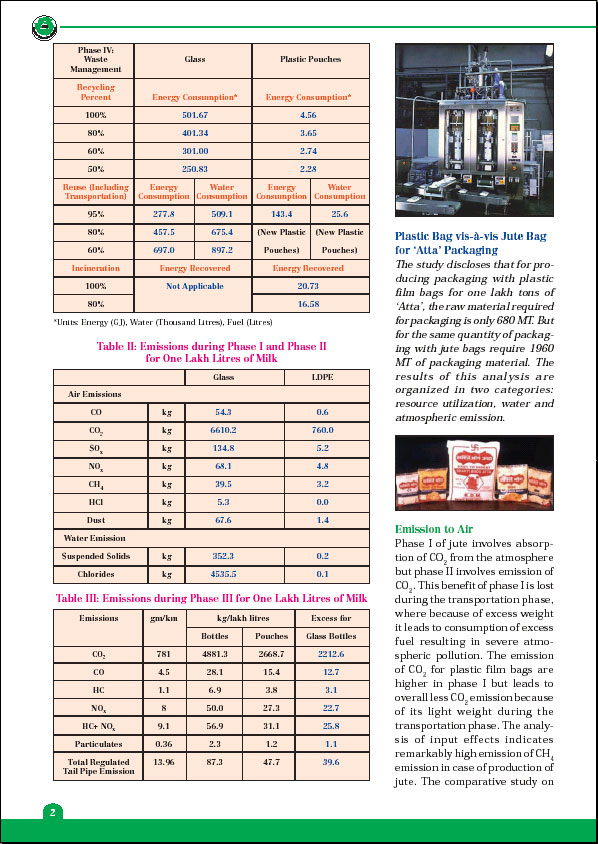
– Plastic Pouch vis-a-vis Glass Bottle for Milk Packaging
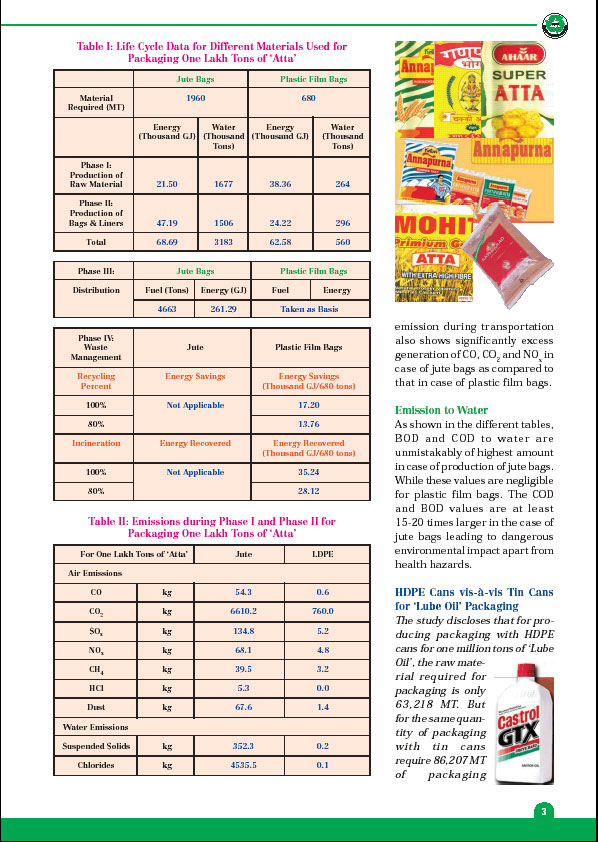
– Plastic Bag vis-a-vis Jute Bag for Atta packaging(Flour)
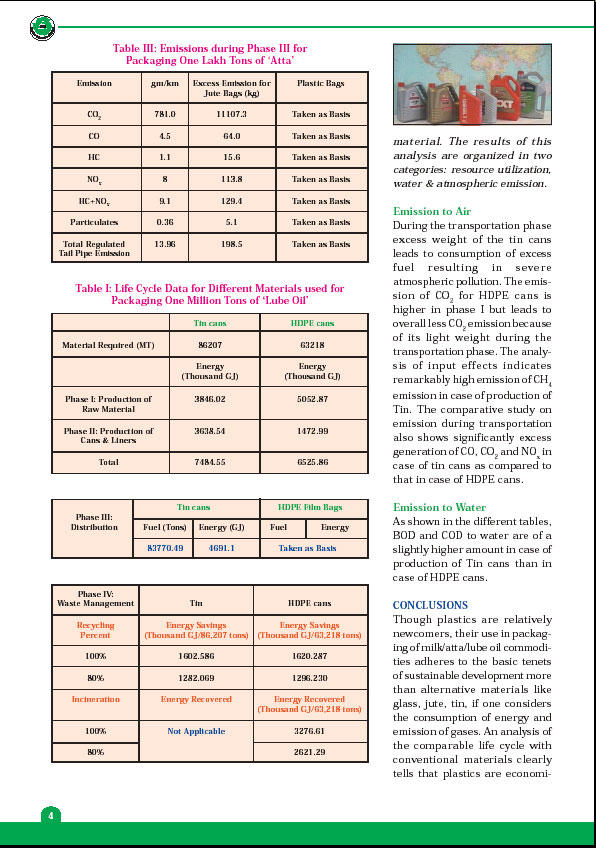
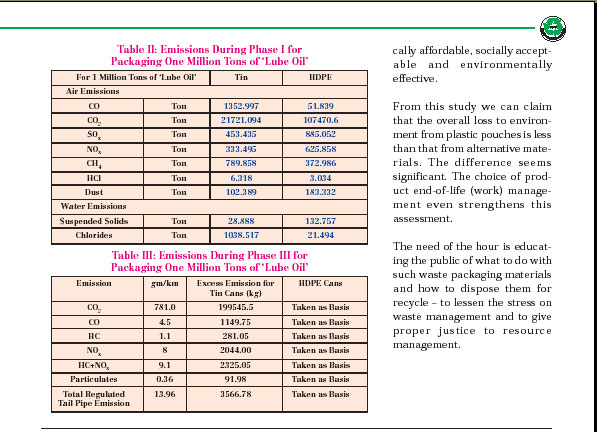
– HDPE Cans vis-a-vis Tin cans for Lube Oil Packaging

For More LCA Studies Please

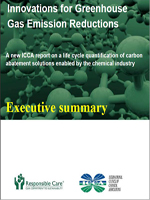
Carbon Life Cycle Analysis by ICCA

Executive summary of the Innovations for Greenhouse gas emission reductions report that ICCA published in Rome on July 7th, right before the G8 summit. It is the ICCA, the world voice of the chemical industry (of which Cefic is a member, from the European side), that produced this report.

FAQs SiteMap Contact Us Login Home Feedback

Mc Kinsey made the search and analysis on behalf of ICCA and the oko Institut (Germany) checked the scientific basis of the carbon Life Cycle Analysis. The Executive Summary of Carbon Life Cycle Analysis (cLCA) of various products as conducted by McKinsey & Co. is given below. Among the Top Ten Greenhouse Gas Emission Saver, Plastics account for four!

  • Plastic in Packaging
  • Plastics in Automobiles
  • Plastics in Insulation materials in construction industry
  • Plastics in Piping

The website address of International Council of Chemical Associations (ICCA) who had organised the study alongwith Responsible Care is www.icca-chem.org

FAQs SiteMap Contact Us Login Home Feedback

Life Cycle Inventory of 100% Postconsumer HDPE and PET Recycled Resin From Postconsumer Containers and Packaging By Franklin Associates

Recycling plastics significantly reduces energy and GHG emissions

A new study using life cycle inventory (LCI) conclusively shows that the recycling of plastics, specifically PET and HDPE, translates into significant savings in energy and greenhouse gas (GHG) emissions. The study, entitled Final Report – Life Cycle Inventory of 100% Postconsumer PET and HDPE Recycled Resin from Postconsumer Containers and Packaging, used LCI methodology to quantify the energy requirements, solid wastes, and atmospheric and waterborne emissions for the processes required to collect post-consumer PET and HDPE packaging, sort and separate the material, and then reprocess it into clean recycled resin. The calculations are based on the tonnage of post-consumer PET and HDPE recovered in the U.S. in 2008, and the energy required to collect, sort and domestically reprocess the tonnage of plastics containers, including bottles, recovered in 2008. Based on the LCI study results, and data from the U.S. Environmental Protection Agency (EPA), the generation of clean recycled resin required 71 trillion Btu less than the amount of energy that would be required to produce the same tonnage of virgin PET and HDPE resin. That’s the amount of energy equivalent to the annual energy use of 750,000 homes in the U.S. The corresponding savings in GHG emission was 2.1 million tons of C02 equivalents – an amount comparable to taking 360,000 cars off the road. The study, conducted by Franklin Associates Ltd., was jointly sponsored by the American Chemistry Council (ACC), the Association of Postconsumer Plastic Recyclers (APR), the National Association for PET Container Resources (NAPCOR) and the PET Resin Association (PETRA). The full report may be accessed by
View PDF Report

Source : Canadian Plastics Industry Associations (CPIA)

Institut für Energie- und Umweltforschung (IFEU) Heidelberg
– Plastic Pouch vis-a-vis Glass Bottle for Milk Packaging
– Plastic Bag vis-a-vis Jute Bag for Atta packaging(Flour)
– HDPE Cans vis-a-vis Tin cans for Lube Oil Packaging