Recycling
- Home
- Plastics
Recycling
The most environmentally friendly alternative for plastic waste disposal – is the process by which we can re-utilize the energy content of the polymer in an ecologically acceptable way. The other two alternatives are Land filling, and Incineration, which have, amongst others, the following constraints, especially because of increasing rapid accumulation of plastic wastes:
(i) Lack of adequate and suitable sites for landfilling.
(ii) The feared toxic emissions from inadequate equipment and inappropriate incineration conditions, and the resultant public resistance.
Types of Recycling
(a) Material Recycling – This practice of recycling post-manufacturing waste has been in vogue since the last many years. But problems are encountered in case of post consumer waste such as great inhomogeneity of different polymers present such as PE/PP, PS, PVC etc. Further the incompatibility of the components mixed, chemically different polymers present pose difficulties in processing and inferior material properties. It is therefore necessary to separate various polymers to boost their value. The separation works based on the principle of sorting by a centrifugal force field, using density difference of the various polymers is one possible solution. Prior to separation, it will be necessary to clean the polymer waste to remove contamination like dirt, food leftovers, paper etc.
(b) Chemical Recycling – Converting polymers back into short chain chemicals for re-use in polymersation or other petro-chemical processes: e.g. – Cracking, Gasification, Hydrogenation and Pyrolysis. Investigations and studies are going on.
Recycling of used plastic containers for liquids
Incompatibility between component polymers (PE, PVC and PF) and degradation of components during the heterogeneous reprocessing results in poor quality of mechanical properties of such secondary plastic materials.
The use of different classes of additives, such as stabilizers, inert fillers, elastomeric modifiers and compatibilizers can improve the processability enhancing the thermo-mechanical resistance of the polymers and the mechanical properties.
To reduce cost, inert fillers can be used, by which mechanical properties will be enhanced, though not to the expected level. Elastomers will improve mechanical properties substantially. Functionalised polyethylene and styrene butadiene-styrene rubber and CaO coated with organo – titanates will help in some compatibilising actions. For blends produced from this mixture and recycled polyethylene good results can be expected.
Recycling - Effects of contamination
In polymers used for recycling, contamination is omnipresent, resulting in reduction of the quality of recycling. It can be in the form of dirt, printing inks, paper, metals, foil, additives, pesticides, partially oxidized polymers, contamination by foreign bodies can be noticed even in PET and HDPE bottles collected from roadsides. In very old scraps of building products, electrical and electronic system, vehicles, furniture etc., which now come for recycling may contain very high concentration of additives in particular, fire retardants, which are now banned. Contamination can be reduced if consumers can be organized to segregate polymer products before disposal. However accidental or unintentional mixtures, multi-component products etc do pose problems.
Common contaminants in recycled polymers:
|
The simple and widely used process for separation is by using differences in density, e.g. HDPE cups and PET bottles.
Separation and purification by chemical reaction process will give better results.
Mixtures of solvents allowing selective dissolution can be used for multi component plastic products.
Different Post Consumer Plastics for Recycling
In the plastic industry, in terms of volume, polyethylenes are the largest group, followed by PVC (Poly vinyl chloride) in the second place.
HDPE (High density Polyethylene) products:
Generally available in bales, low cost.
Products: milk jugs and detergent bottles. High-density polyethylene – almost as dense as water, natural in colour, transparent, white, without any pigment. During recycling any colour can be mixed.
Process of recycling is very simple – Grind into small flakes approx. 1 cm., wash, float and remove heavy contaminant, dry the clean flakes in a stream of hot air, pack in boxes – ready for sale.
Reheat the flakes, add pigments of choice, colour and run through a pelletizer. By using injection moulding presses new products can be made out of the little beads that may be formed in the process of pelletizing.
End uses: Pipes, lumber, flowerpots, trashcans, and non-food application bottles.
LDPE (Low Density Poly Ethylene)
LDPE available in bales – low cost. Chemically similar to HDPE but less dense and more flexible., e.g. Polyethylene films used for plastic bags and in grocery sacks.
Process is similar to HDPE, and special grinders are used when thin films are required.
End use – Plastic trash bags grocery sacks, tubing, agricultural films and lumber.
PET (Poly Ethylene Terephthalate)
A thin strong polyester film, extremely tough. Used for softdrink and water bottles, jars, clamshell packages like cooking containers or trays etc.
Process: – Similar to the process for Polyethylene. Sort out based on colour, grind & wash. PET sinks in the wash water when plastic caps and labels will float. The clean flake is dried and often repelletized.
End use: Largest usage is in Textiles. Carpet companies often use 100 % recycled resin to manufacture Polyester carpet in different colours and textures, fibre filling for pillows, quilts and jackets clear sheets or ribbon for VCR and audio cassettes. A good quantity goes back into the bottle market. Cost varies widely with supply.
PVC (Poly Vinyl Chloride):
PVC is a versatile and universal polymer, low cost.
PVC can be compounded with variety of additives to make wide range of flexible and rigid forms and hence versatile. PVC is a universal polymer because it can be processed by various techniques like calendering, extrusion, injections, moulding and plastosol. Physical chemical, weathering properties of PVC are excellent.
End uses: – Pipes, Profiles, Floor coverings, cable insulation, roofing sheets, packaging foils, bottles and medical products, car interiors.
Advantages: Easy to clean, Water proof and resistant to corrosion.
Recycling of Plastics: Indian Context
Recycling of Plastics has been classified into 4 main categories:
- Primary Recycling – conversion of waste plastics into products having performance level comparable to that of original products made from virgin plastics.
- Secondary Recycling – conversion of waste plastics into products having less demanding performance requirements than the original material.
- Tertiary Recycling – the process of producing chemicals / fuels / similar products from waste plastics.
- Quaternary Recycling – the process of recovering energy from waste plastics by incineration.
The present article deals with the first two categories of Recycling.
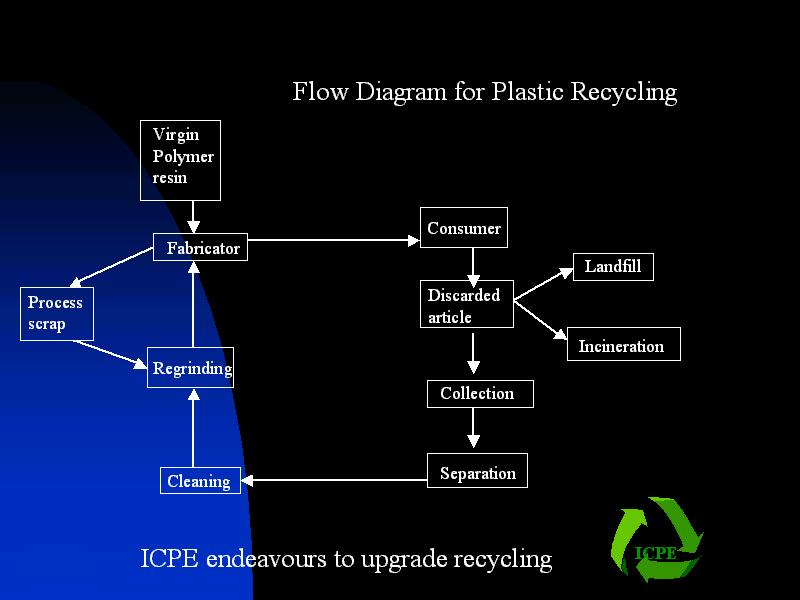
The process of recycling of waste plastics into products of varying usefulness mostly involves the following essential steps:
- Collection Segregation.
- Cleaning & Drying.
- Sizing / Chipping.
- Agglomerating / Colouring
- Extrusion / Palletisation
- Fabrication into end Product.
Each of the above steps involves a series of operations.
Collection / Segregation:
The basic principle of plastic / polymer processing is that the polymeric materials under process are required to be compatible with each other, if more than one type of plastic materials are involved..
Certain polymeric materials are compatible with each other at all proportions.For example LDPE and Lldpe are generally compatible to each other at all proportions.
However, it is to be remembered that even differing molecular weight variety of the same polymer may not be compatible for useful purpose. For example phase separation may occur if a high molecular weight (low Melt Flow Index) grade of LDPE (e.g. heavy duty film grade) is processed with a very low molecular weight (high Melt Flow Index) grade of LDPE (e.g. high flow Injection Moulding grade).
The advanced technology of separating / segregating different types of waste plastics involves ‘Floatation Process’. In this process the property of the varying densities of different plastics is made use of for segregating different types of plastics.
However in the Indian Context, this separation or segregation process, in many cases, are done by manual process utilizing the availability of cheap and expert labour force.In case the waste is contaminated with embedded metals, proper method of separating the metals / other contaminants, is required.
Cleaning & Drying:
The scale of cleaning depends on the type of waste.
Generally, Industrial waste does not require significant cleaning operation, whereas, post-consumer waste requires proper cleaning.
Whenever a cleaning operation is involved, it is to be ensured that the water or any other cleaning material used, should be discharged after ascertaining that the discharge does not contain any objectionable substance. A proper Treatment Device may have to be deployed – like a water treatment plant / effluent treatment plant.
For drying, a suitably designed drier is used.
Many industries situated out side the metropolises, use open space for natural drying of the cleaned waste.
Sizing / Chipping:
The cleaned plastics waste is then required to be properly sized so that those may be fed into the extruders for processing and palletizing. The sizing operation depends on the type and shape of the waste plastics.
During this process, attention is required to separate any powdery material from the sized / chipped plastics.
Agglomerating / Colouring
In the next operation the sized plastics waste is mixed with colour master batch in high-speed mixers / agglomerators and the output is ready for extrusion into pellets.
Extrusion / Palletisation
This is the most important part of the process wherein the sized / chipped plastics are plasticised and regranulated to make the plastics material ready for fabrication next.
The type and size of the Extruder depend on the type and volume of the plastics waste.
Fabrication into end Product
Finally the reprocessed plastics granules are used as raw material for producing end products using similar fabrication machines like Injection Moulding / Extrusion etc., depending upon specific requirement.
Flow diagram for Recycling
News Items / Special information
Recycled Plastic Lumber - A deck, Chair or even railroad ties made out of Plastic ?
Eurobodalla Recycling in good hands - (Narooma News - Narooma,New South Wales,Australia).
Recycling Issues in Australia
Recycling Issues, have been quite high on the agenda in Australia for some time now. There are quite some information available which will be useful to all concerned. In this respect it may be useful following websites :-
http://www.ecorecycle.vic.gov.au/www/default.asp?casid=2487
PACIA, the Australian Plastics and Chemical Industry Association(which includes the results of the latest plastics recycling survey)https://chemistryaustralia.org.au/
Resource NSW (the NSW equivalent of EcoRecycle Victoria) which is to be integrated into the Department of Environment and Conservation(DEC) Visy Recycling at the leading AUstralian company in plastics recycling(including collection and sorting)Recycling plastics significantly reduces energy and GHG emissions
A new study using life cycle inventory (LCI) conclusively shows that the recycling of plastics, specifically PET and HDPE, translates into significant savings in energy and greenhouse gas (GHG) emissions. Source :Canadian Plastics Industry Associations (CPIA)
For More Details….Click Here
Recycling of Heterogeneous Plastics
Degradation of polymers during different processing steps is the main problem in post consumer plastics recycling. Incompatibility among the different phases also poses major difficulty in the recycling of heterogeneous waste.