
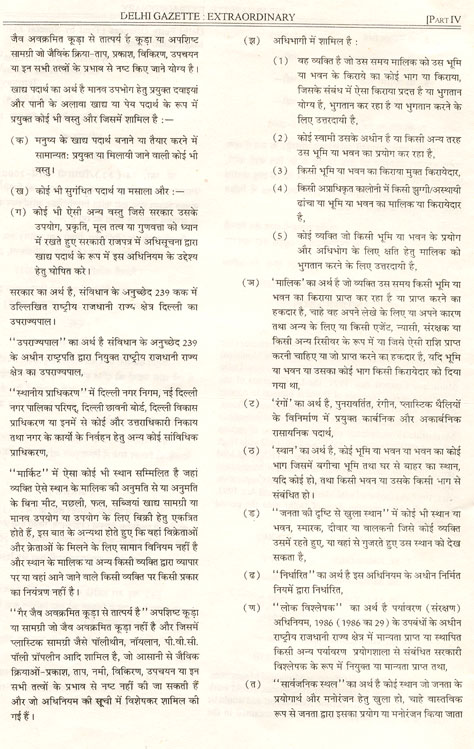
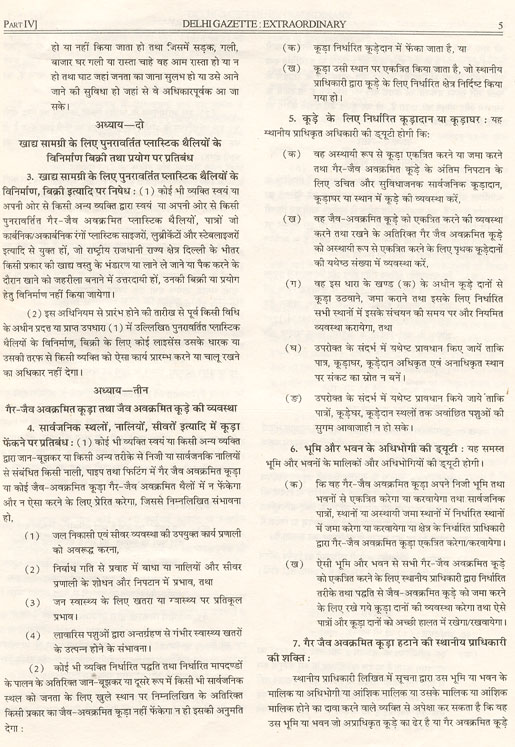
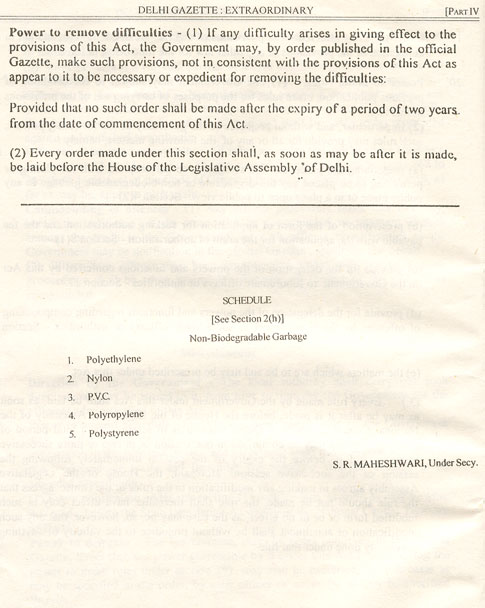
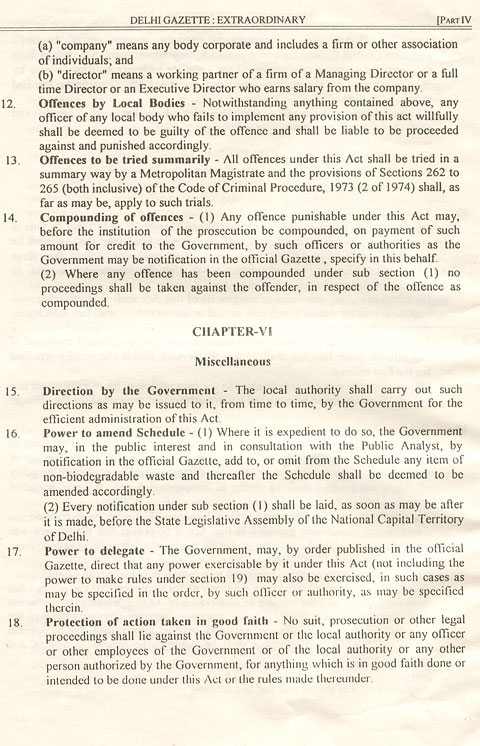
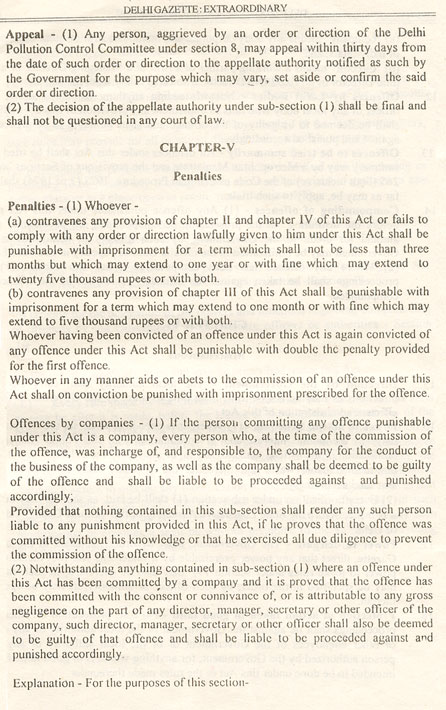
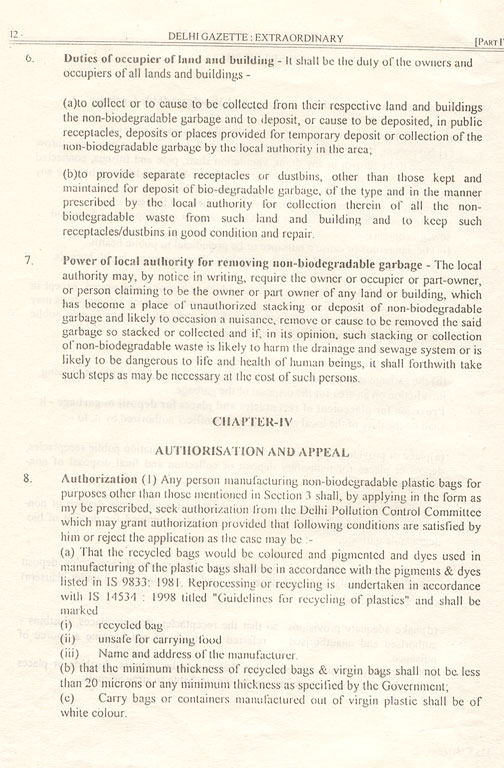
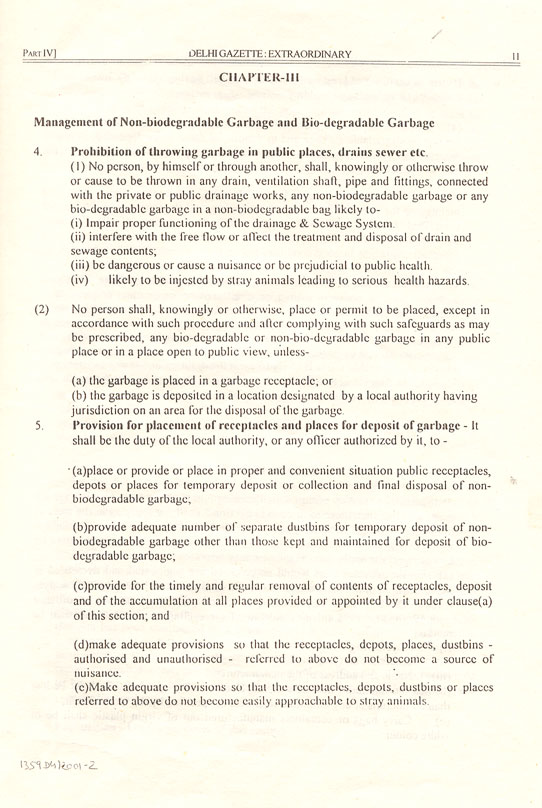
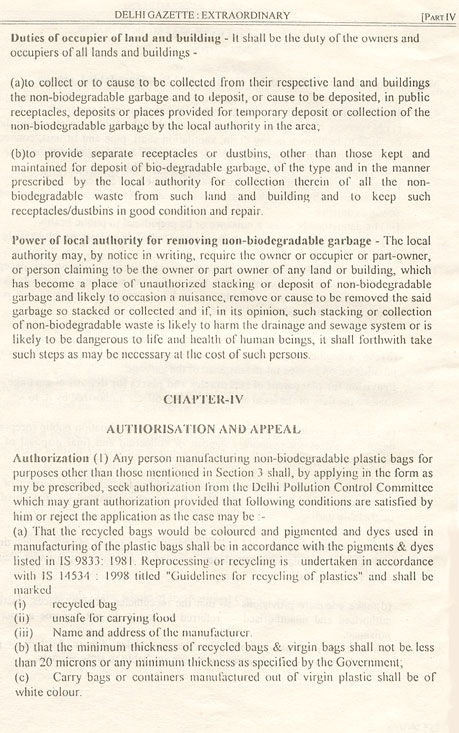
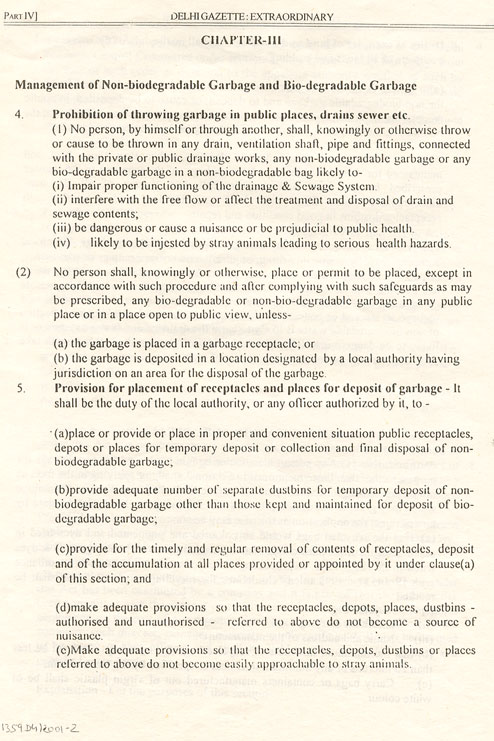
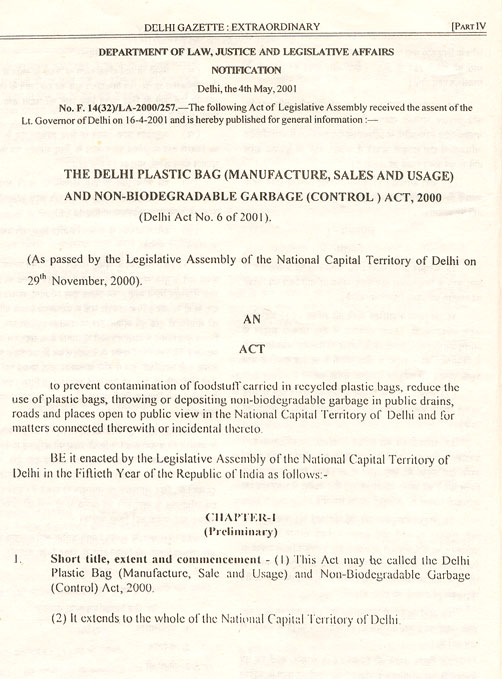
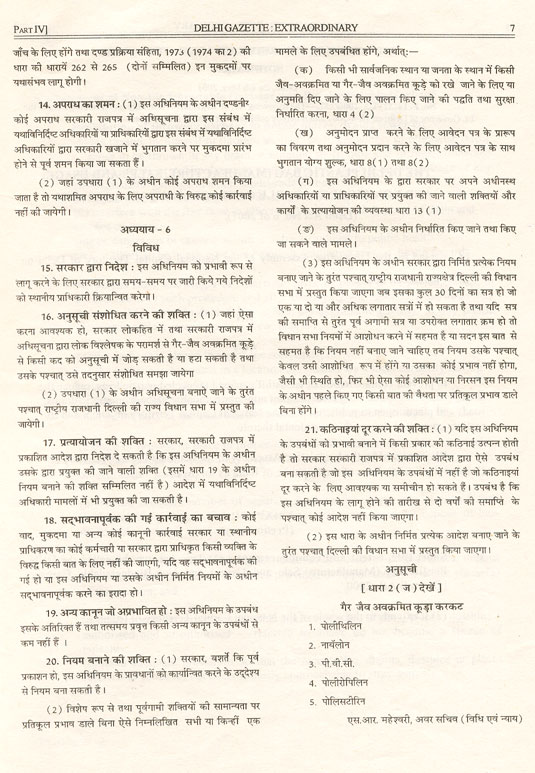
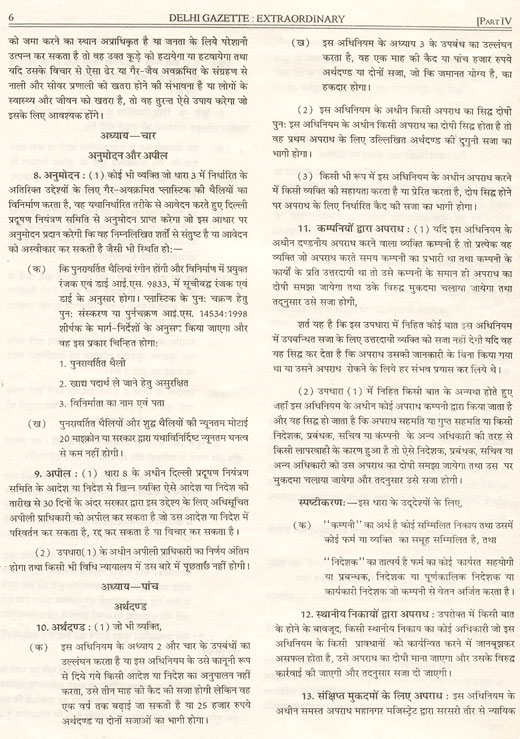
The Delhi plastic bag (Manufacture, Sales and Usage) And Non-Biodegradable Garbage(Control) Act, 2000.
(As passed by the Legistative Assembly of the National Capital Territory of Delhi on 29th November, 2000)
An act to prevent contamination of food stuff carried in recycled plastic bags, reduce the use of platics bags;
MINISTRY OF ENVIRONMENT AND FORESTS
The delhi plastic bag (Manufacture, Sales and Usage) And Non-Biodegradable Garbage(Control) Act, 2000.
(Delhi Act No. 6 of 2001)
No. F. 14(32)/LA-2000/257
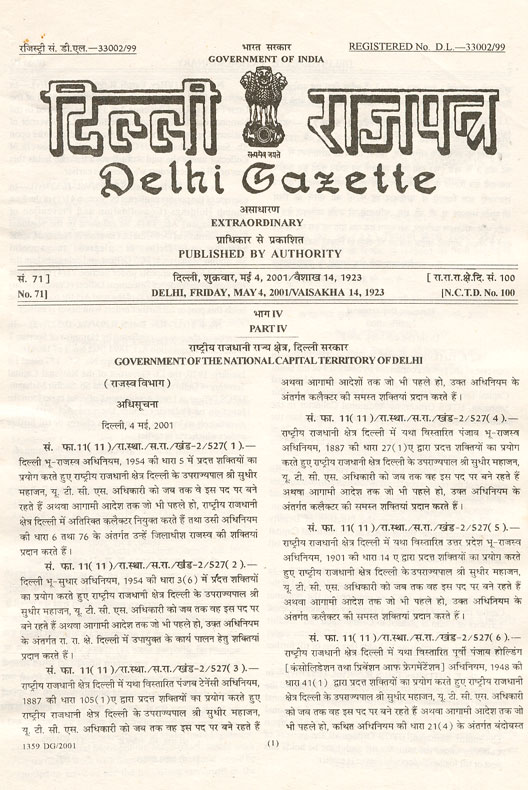
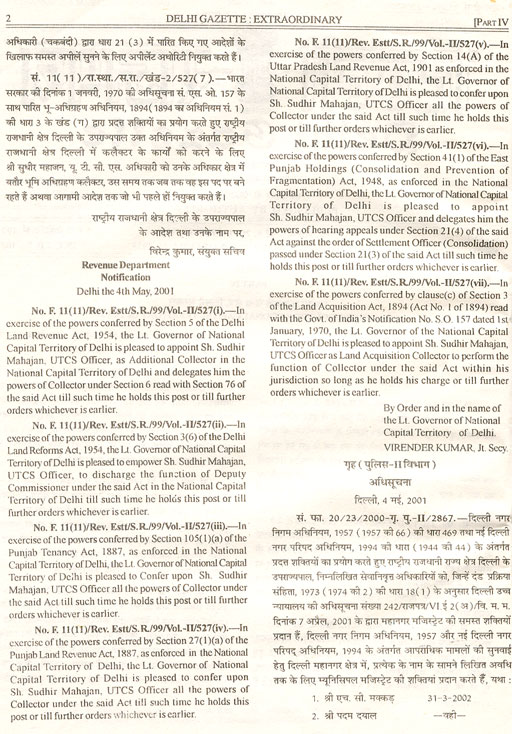
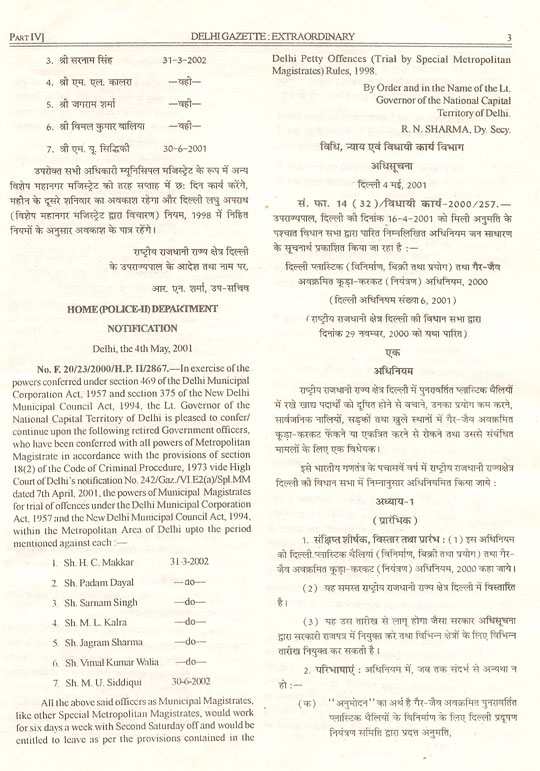
Department of law, justice and legislative affairs notification Delhi, the 4th May, 2001 No. F. 14(32)/LA-2000/257
Bio-Medical Waste(Management and Handling) (Amendment) Rules,2003
S.O. 1069(E).- In exercise of the powers conferred by sections 6, 8 and 25 of the Environment ( Protection) Act, 1986 ( 29 of 1986), the Central Government hereby makes the following rules further to amend the Bio-Medical Waste ( Management and Handling) Rules, 1998
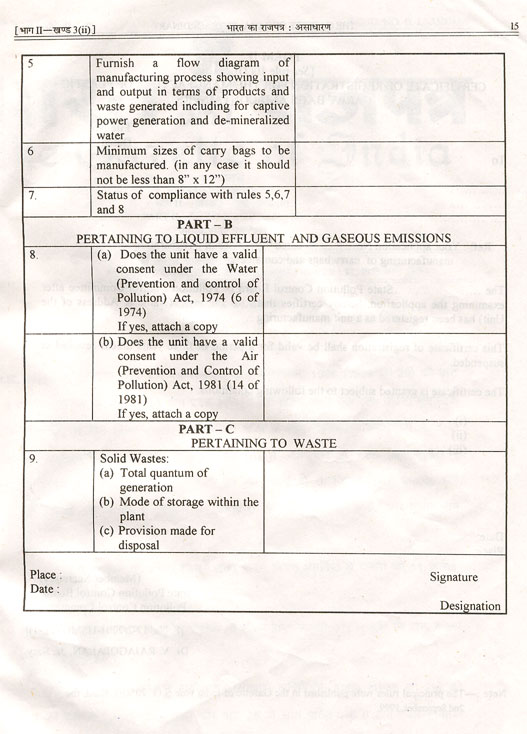
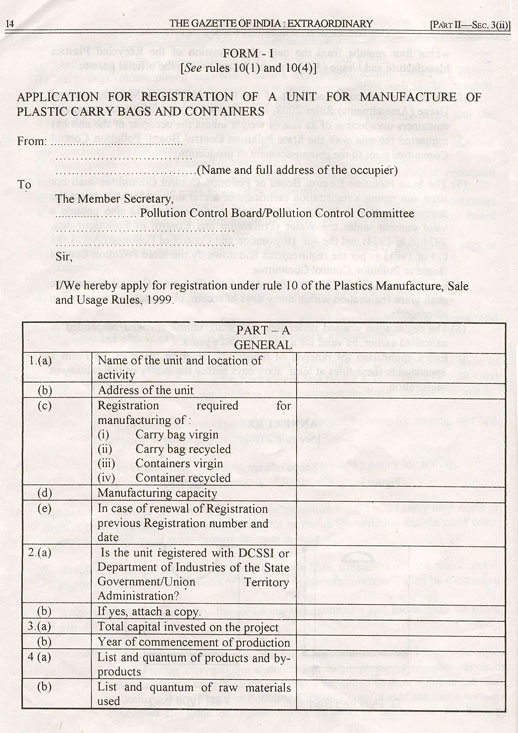
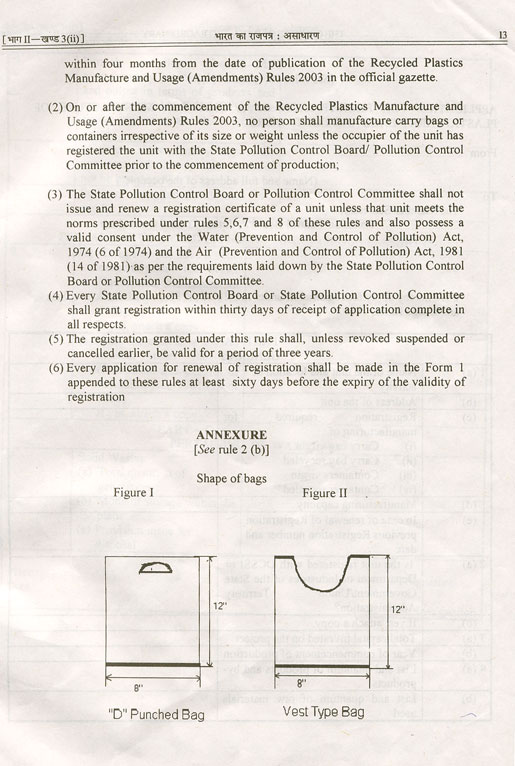
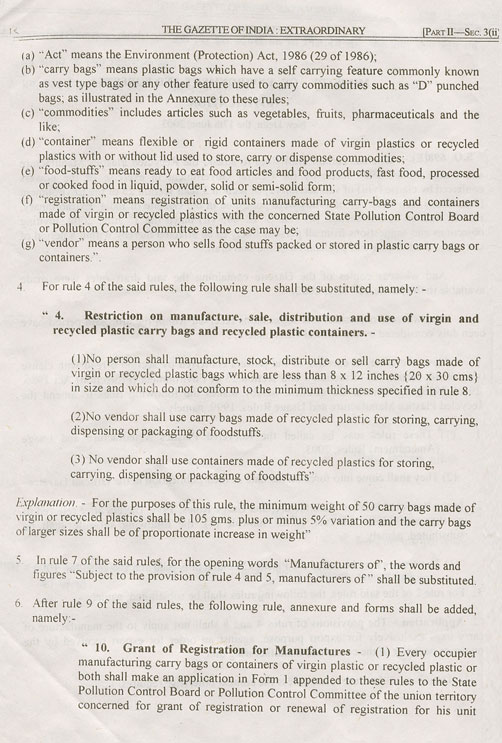
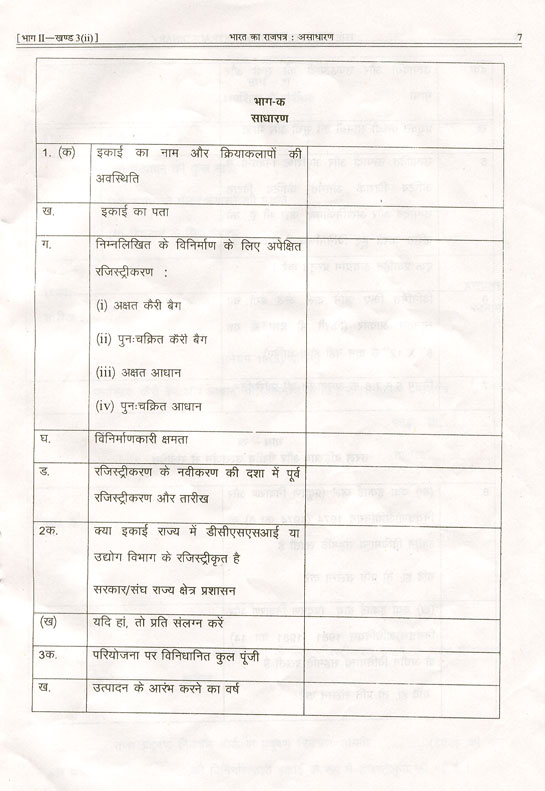
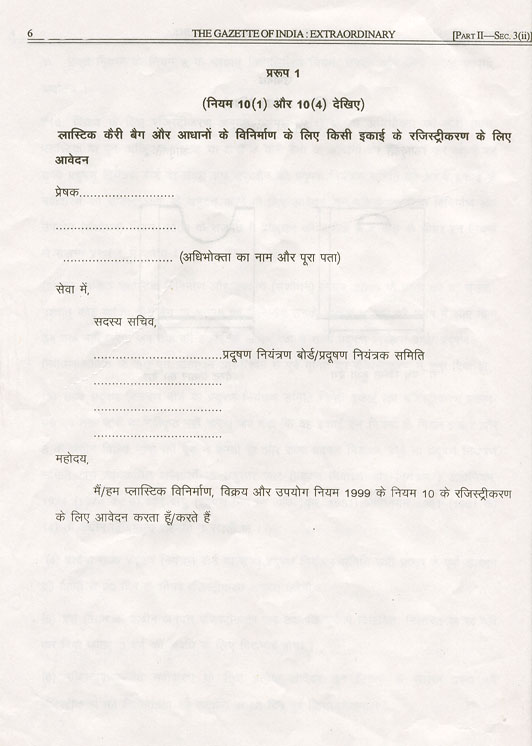
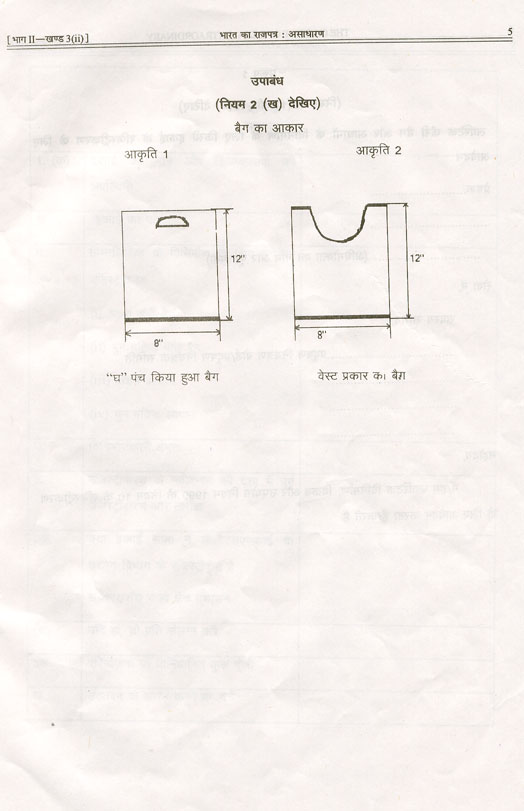
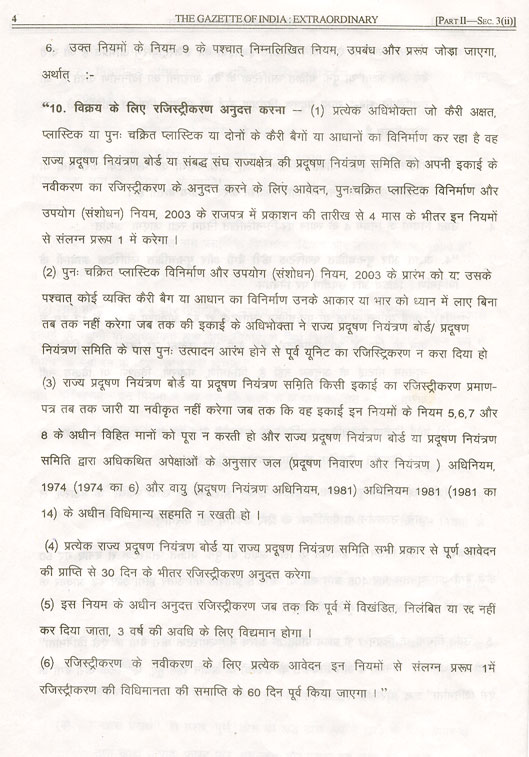
The Recycled Plastics Manufacture and usage Amendment Rules, 2003.
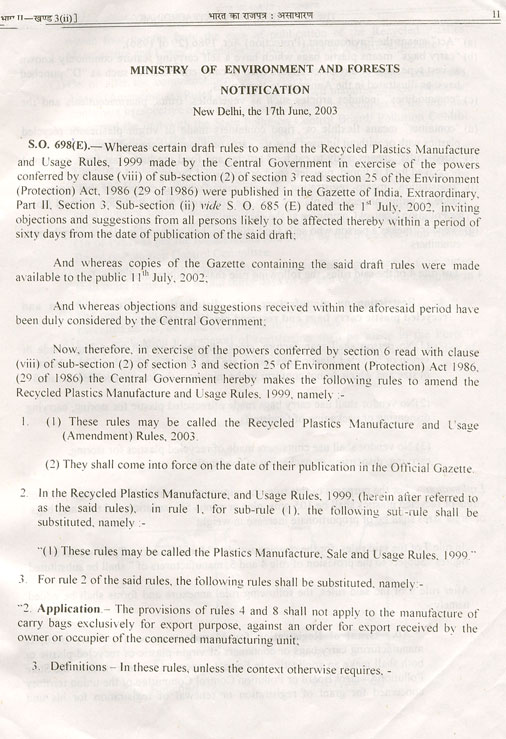
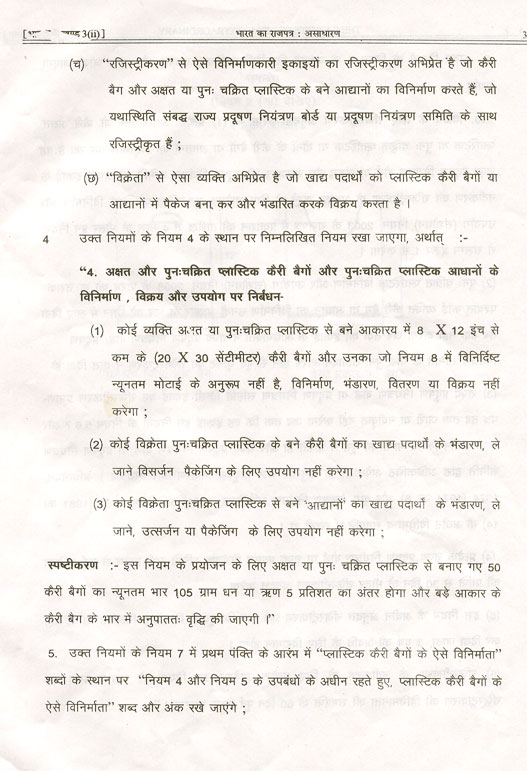
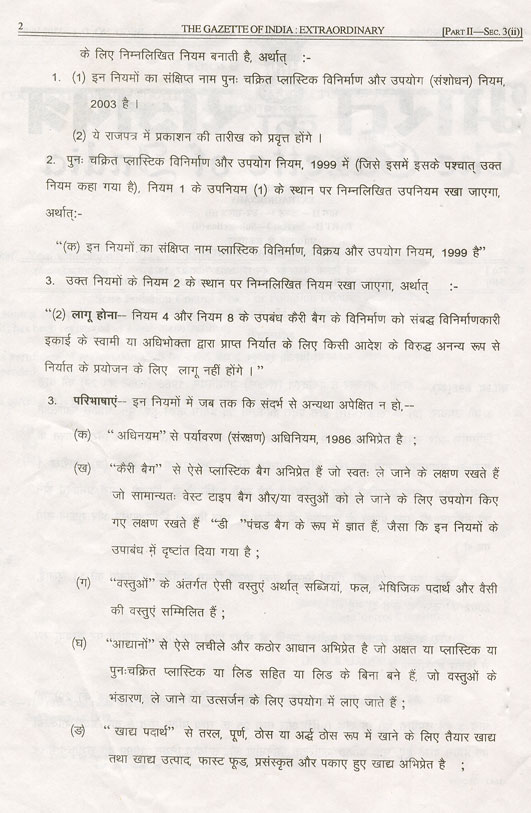
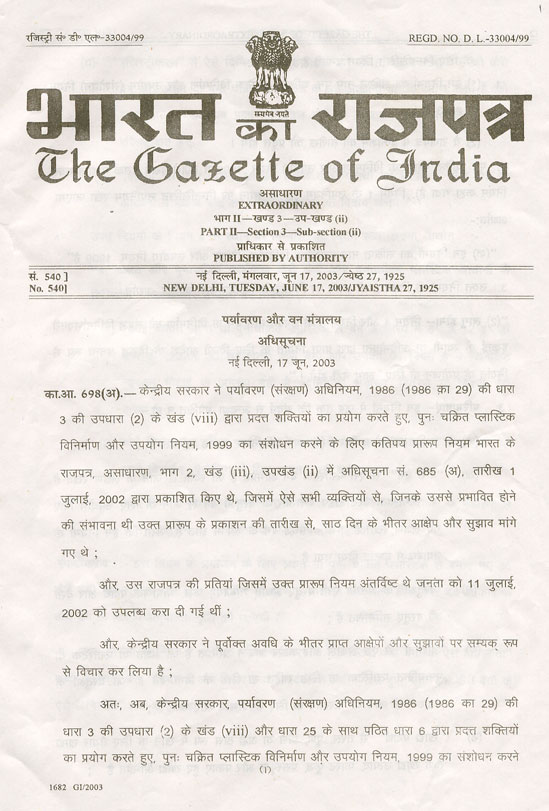
S.O. 698(E).- Whereas certain draft rules to amend the recycled plastics manufacture and usage rules. 1999 made by the central government in exercise of the powers conferred by clause (viii) of sub-section(2) of section 3 read section 25 of the environment(Protection) Act, 1986(29 of 1986) were published in the Gazette of India
MINISTRY OF ENVIRONMENT AND FORESTS
The Recycled Plastics Manufacture and usage Amendment Rules, 2003.
S.O. 698(E).
Ministry of environment and forests notification - S.O. 698(E)
Hazardous Wastes (Management and Handling) Amendment Rules, 2003
S.O. 593(E).- Whereas the draft of certain rules called the Hazardous Wastes (Management and Handling) Amendment Rules, 2002 was published under the notification of the
Government of India in the Ministry of Environment and Forests number S.O. 553(E), dated
21st May, 2002 in the Gazette of India, Part-II, Section 3, Sub-section (ii) of the same date
inviting objections and suggestions from all persons likely to be affected thereby, before the
expiry of the period of sixty days from the date on which copies of the Gazette containing the
said notification were made available to the public.
The Recycled Plastics Manufacture and usage Amendment Rules, 2002.
S.O. 685(E).— In exercise of the powers conferred by sections 6, 8 and 25 of the Environment (Protection) Act, 1986 (29 of 1986), the following draft of an amendment to the Recycled Plastics Manufacture and usage Rules, 1999 is hereby published , for the information of all persons likely to be affected thereby and notice is hereby given that the said Amendment rules will be taken into consideration after the expiry of a period of 60 days from the date on which the gazette copies containing this notification are made available to the public;
The Municipal Solid Wastes (Management and Handling) Rules, 2000.
S.O. 908(E).- Whereas the draft of the Municipal Solid Wastes (Management and Handling) Rules, 1999 were published under the notification of the Government of India in the Ministry of Environment and Forests number S.O. 783(E), dated, the 27th September, 1999 in the Gazette of India, Part II, Section 3, Sub-section (ii) of the same date inviting objections and suggestions from the persons likely to be affected thereby, before the expiry of the period of sixty days from the date on which the copies of the Gazette containing the said notification are made available to the public
Hazardous Wastes (Management and Handling) Amendment Rules, 2000
S.O. 24(E).- Whereas a notification of the Government of India in the Ministry of Environment and Forests was published in the gazette of India, Extraordinary, Part II-Section 3, Sub-section (ii) vide No.S.O.10 (E) dated 8th January, 1999 under powers conferred by sections 6, 8 and 25 of the Environment (Protection) Act, 1986 (29 of 1986), inviting objections from persons likely to be affected within a period of sixty days from the date of publication of the notification with regard to the Government’s intention to amend the Hazardous Wastes (Management and Handling) Rules, 1989
Ministry of Environment & Forests - Notifications
New Delhi, the 6th January, 2000.
S.O. 24(E).- Whereas a notification of the Government of India in the Ministry of Environment and Forests was published in the gazette of India, Extraordinary, Part II-Section 3, Sub-section (ii) vide No.S.O.10 (E) dated 8th January, 1999 under powers conferred by sections 6, 8 and 25 of the Environment (Protection) Act, 1986 (29 of 1986), inviting objections from persons likely to be affected within a period of sixty days from the date of publication of the notification with regard to the Government’s intention to amend the Hazardous Wastes (Management and Handling) Rules, 1989.
And, whereas, objections received within the period were duly concerned by the Central Government;
Now, therefore, in exercise of the powers conferred by section 6, 8, 25 of the Environment (Protection) Act, 1986 the Central Government hereby notifies the amendments to the Hazardous Wastes (Management and Handling) Rules, 1989.
Hazardous Wastes (Management and Handling) Amendment Rules, 2000
- These rules may be called the Hazardous Wastes (Management and Handling) Amendment Rules, 2000;
- They shall come into force on the date of their publication in the Official Gazette;
- In the Hazardous Wastes (Management and Handling) Rules, 1989 (hereinafter referred to as the said rules):
- In rule 2:
- After the words “These rules shall apply to”, the words “the handling of” will be inserted;
- After the words “as specified in”, the word “schedule” shall be substituted by the word “schedules”.
- In rule 3 of the said rules:
- For sub-rule (i), the following sub-rule shall be substituted, namely:
“(i) Hazardous Wastes means:
- Waste substances which are generated in the process indicated in column-2 of Schedule-1 and consist wholly or partly of the waste substances referred to in column-3 of the same schedule;
- Waste substances which consist wholly or partly of substances indicated in Schedule-2, unless the concentration of the substances is less than the limit indicated in the same schedule; and
- Waste substances indicated in Part-A, List ‘A’ and ‘B’ of Schedule-3 applicable only to rule 12, 13 and 14 unless they do not possess any of the hazardous characteristics in Part-B of the same schedule.”
- After sub-rule (p), the following sub-rules shall be inserted, namely:
- ‘disposal’ means deposit, treatment, storage and recovery of any hazardous wastes;
- ‘manifest’ means transporting document originated and signed by the occupier in accordance with rule 7(4) and 7(5);
- ‘State Government’ means State Government and in relation to Union Territory the Administrator thereof appointed under Article 239 of the Constitution;
- ‘storage’ means keeping hazardous wastes for a temporary period, at the end of which the hazardous waste is treated and disposed of;
- ‘transport’ means movement of hazardous waste by air, rail, road or water;
- ‘transporter’ means a person engaged in the off-site transportation of hazardous waste by air, rail, road or water;
- ‘treatment’ means a method, technique or process, designed to change the physical, chemical or biological characteristics or composition of any hazardous waste so as to render such wastes harmless;
- “environmentally sound management of hazardous wastes” means taking all steps to ensure that the hazardous wastes are managed in a manner which will protect human health and the environment against the adverse effects which may result from such wastes;
- “illegal traffic” means any transboundary movement of hazardous wastes as specified in rule 15;
- Sub-rule (q) shall be re-lettered as sub-rule “(z)”.
- For sub-rule (i), the following sub-rule shall be substituted, namely:
- In rule 4 of the said rules:
- For the heading “4. Responsibility of the occupier for handling of wastes”, the words “4. Responsibility of the occupier and operator of a facility for handling of the wastes” shall be substituted;
- For sub-rule (1), the following sub-rule shall be substituted, namely:
“(1) The occupier and the operator of a facility shall be responsible for proper collection, reception, treatment, storage and disposal of hazardous wastes listed in Schedules 1, 2 and 3.”
- After sub-rule (2), the following sub-rule shall be inserted, namely:
“(3) It shall be the responsibility of the occupier and the operator of a facility to take all steps to ensure that the wastes listed in Schedules 1, 2 and 3 are properly handled, and disposed of without any adverse effects to the environment.”
- After rule 4, the following rules shall be inserted, namely:
“4A. Duties of the occupier and operator of a facility: It shall be the duty of the occupier and the operator of a facility to take adequate steps while handling hazardous waste to:
- Contain contaminants and prevent accidents and limit their consequences on human and the environment; and
- Provide persons working on the site with information, training and equipment necessary to ensure their safety.
- In rule 5 of the said rules:
- In sub-rules (2), (3), (4) and (7) for the words “State Pollution Control Board” the words “Member-Secretary, State Pollution Control Board or any officer designated by the Board” shall be substituted;
- In sub-rule (2) and sub-rule (3) after the words “Form 1” the following shall be inserted, namely: “along with a sum of rupees seven thousand five hundred only for processing application for authorization and analysis fee, if required, as prescribed under the Environment (Protection) Act, 1986”;
- After sub-rule (4), the following sub-rule shall be inserted, namely:
“(4A) The authorisation application complete in all respects shall be processed by the State Pollution Control Boards within ninety days of the receipt of such application”;
- In sub-rule (6)(i) for the words “a period of two years from” the words “for a period of five years from” shall be substituted;
- After sub-rule (7), the following sub-rule shall be inserted, namely:
“(8) The Member-Secretary, State Pollution Control Board or any officer designated by the Board shall renew the authorisation granted under sub rule (6), after examining each case on merit, subject to the following:
- on submission of annual returns by the occupier or operator of facility in Form 4;
- on steps taken, wherever feasible, for reduction in the waste generated or recycled or reused;
- on fulfilment of conditions prescribed in the authorisation regarding management in an environmentally sound manner of wastes; and
- on remittance of a processing application fee and analysis fee, as the case may be.”
- In rule 2:
- In Rule 7 of the said rules:
- For sub-rule (1), the following shall be substituted, namely:
“(1) The occupier or operator of a facility shall ensure that the hazardous wastes are packaged, based on the composition in a manner suitable for handling, storage and transport and the labelling and packaging shall be easily visible and be able to withstand physical conditions and climatic factors.”
- For sub-rule (2), the following sub-rule shall be substituted, namely:
“(2) Packaging, labelling and transport of hazardous wastes shall be in accordance with the provisions of the rules made by the Central Government under the Motor Vehicles Act, 1988 and other guidelines issued from time to time.”
- After sub-rule (2), the following sub-rules shall be inserted, namely:
“(3) All hazardous waste containers shall be provided with a general label as given in Form 8.”
“(4) No transporter shall accept hazardous wastes from an occupier for disposal unless it is accompanied by five copies of the manifest (Form 9) as per the colour codes. The transporter shall give a copy of the manifest signed and dated to the occupier and retain the remaining four copies to be used as prescribed in sub-rule (5).”
“(5) Occupier shall provide the transporter with six copies of the manifest as per the colour codes indicated below:”
- Copy 1 (White): forwarded to the Pollution Control Board by the occupier
- Copy 2 (Light Yellow): signed by the transporter and retained by the occupier
- Copy 3 (Pink): retained by the operator of a facility
- Copy 4 (Orange): returned to the transporter by the operator of the facility after accepting waste
- Copy 5 (Green): forwarded to Pollution Control Board by the operator of the facility after disposal
- Copy 6 (Blue): returned to the occupier by the operator of the facility after disposal
The occupier shall obtain necessary no-objection certificate from State Pollution Control Boards in the respective states involved in case of any inter and intra State transport of hazardous wastes; The occupier shall provide the transporter with relevant information in Form 10, regarding the hazardous nature of the wastes and measures to be taken in case of an emergency.”
- For sub-rule (1), the following shall be substituted, namely:
- In the said rules, for rule 8, the following rule shall be substituted, namely:
“8. Disposal Sites:
- The occupier or any operator of a facility shall be responsible for identifying sites for establishing hazardous wastes disposal facility;
- The State Government, operator of a facility or any association of occupiers shall identify sites for common hazardous wastes disposal facility in the state;
- The State Government, occupier or any association shall after preliminary impact assessment studies identify possible sites for disposal facility. They shall then undertake an Environmental Impact Assessment of these sites for selecting an appropriate site for hazardous waste disposal facility;
- The occupier or any association after identification as prescribed in sub-rule (3) shall inform the State Government to take necessary action for notifying of the site;
- The State Government shall after identification or on receipt of information regarding identification by such occupier or any such association shall cause a public notice inviting objections and suggestions within thirty days;
- The State Government shall on receipt of any objection conduct a public hearing as per the procedure notified for Environmental Impact Assessment;
- The State Government shall then, acquire or inform such occupier or any such association to acquire the site before notifying the same. It shall also undertake to compile and publish periodically an inventory of such disposal sites in the state.”
- After rule 8 of the said rules, the following rules shall be inserted, namely:
“8A. Design and setting up of disposal facility:
- The occupier, any association or operator of a facility, as the case may be shall design and set up disposal facility as per the guidelines issued by the Central Government or the State Government as the case may be;
- The occupier, any association or operator, shall before setting up a disposal facility get the design and the layout of the facility approved by the State Pollution Control Board;
- The State Pollution Control Board shall monitor the setting up and operation of a facility regularly.”
- The occupier or the operator as the case may be, shall be responsible for safe and environmentally sound operation of the facility as per design approved under Rule 8A by the State Pollution Control Board;
- The occupier or the operator shall ensure that the closure of the landfill is as per the design approved under Rule 8A by the State Pollution Control Board.”
- For rule 11 of the said rules, the following rule shall be substituted, namely:
“11. Import and Export of Hazardous Wastes for dumping and disposal: Import of hazardous wastes from any country to India and export of hazardous wastes from India to any country for dumping or disposal shall not be permitted.”
- After rule 11, the following rules shall be inserted, namely:
“12. Import and Export of Hazardous Wastes for recycling and reuse:
- Import and/or export of hazardous wastes under rule 3(i)(c) shall only be permitted as raw material for recycling or reuse;
- The Ministry of Environment and Forests shall be the nodal Ministry to deal with transboundary movement of hazardous waste;
- For regulation of export and import the authorities mentioned in Schedule 4 shall be responsible;
- The decision of the Central Government in respect of grant of permission for import or export shall be final;
- Any occupier importing or exporting hazardous waste shall provide detailed information in Form 7A to the Customs authorities;
- Any occupier exporting or importing hazardous waste from or to India shall comply with the articles of the Basel Convention to which the Central Government is a signatory.”
- 13. Import of Hazardous Waste:
- Every occupier importing hazardous waste shall apply to the State Pollution Control Board, one hundred twenty days in advance in Form-6 for permission to import along with the prescribed fee;
- The State Pollution Control Board shall examine the application within thirty days and forward it with recommendations to the Ministry of Environment and Forests;
- The Ministry of Environment and Forests shall examine the application and grant permission for import subject to environmentally friendly technology, capability, facilities, approvals, and fees;
- The Ministry shall forward a copy of the permission to the Central Pollution Control Board, the State Pollution Control Board, and Port and Customs authorities;
- An application for licence to the Directorate General of Foreign Trade must include the permission granted;
- Port and Customs shall ensure shipping documents are accompanied by authenticated Forms;
- The occupier shall inform authorities ten days in advance of the consignment’s arrival;
- The occupier shall maintain import records as specified in Form 6A and make them available for inspection.”
- 14. Export of Hazardous Waste:
- The exporting country or exporter shall apply ninety days in advance in Form 7 to the Ministry of Environment and Forests;
- The Ministry shall examine the application and grant or refuse permission;
- The Ministry shall communicate permission by authentication on Form 7 to the exporter, exporting country, CPCB and SPCB;
- No consignment shall be shipped prior to authentication. The exporter must ensure shipping documents are accompanied by Form 7A, authenticated Form 7 and test reports;
- Exporters shall seek permission from the receiving country’s competent authority prior to shipment;
- Every occupier exporting hazardous waste shall inform the Central Government of permissions sought and granted using Form 7.”
- Illegal Traffic:
- The movement of hazardous wastes shall be considered illegal if:
- It is without prior permission;
- Permission has been obtained through falsification or fraud;
- It does not conform to the shipping details in the document.
- In case of illegal movement:
- The waste shall be shipped back within thirty days or disposed of within thirty days;
- In case of illegal transboundary movement, the wastes shall be safely stored, shipped or disposed of within thirty days;
- The exporting country shall bear disposal costs.
- The movement of hazardous wastes shall be considered illegal if:
- Liability of the occupier, transporter and operator of a facility:
- The occupier, transporter and operator shall be liable for damages caused to the environment due to improper handling and disposal of hazardous waste;
- The occupier and operator shall reinstate or restore damaged elements of the environment;
- The occupier and operator shall pay fines as levied by SPCB with CPCB approval for violations of these rules.”
- Transitional provisions:
- On the date of coming into operation of these rules, an occupier shall comply within three months;
- State Pollution Control Boards and Pollution Control Committees shall oversee compliance.”
- Appeal:
- An appeal shall lie, against any order of grant or refusal of an authorisation by the Member-Secretary, SPCB or any designated officer to the Secretary, Department of Environment of the State Government;
- Every appeal shall be in writing, accompanied by the order appealed against and presented within thirty days of receipt of the order.”
- In Form 1, add at the bottom of item 8:
Place Signature Date Designation - In Form 2, for the words “(Authorisation for operating a facility for collection, reception, treatment, storage, transport and disposal of hazardous wastes)” substitute with “Form for Grant of authorisation for occupier or operator handling hazardous wastes.”
- In Form 3, after item 7, insert:
"8. Details of the hazardous wastes reused and recycled -

Date

Total quantity of hazardous waste generated

Details of hazardous waste minimisation activity

Material received

Final quantity of waste generated

Net reduction waste generation quantity and percentage

Place:

Signature

Date:

Designation"
FORM – 6 : Application for importing hazardous/recyclable wastes as raw materials
FORM – 7 : Transboundary Movement of Waste- NOTIFICATION
SCHEDULE – I : List of processes generating hazardous wastes
SCHEDULE – II : LIST OF WASTE SUBSTANCES WITH CONCENTRATION LIMITS
SCHEDULE – III : LISTS OF WASTE TO BE APPLICABLE ONLY FOR IMPORTS AND EXPORTS
SCHEDULE – IV : Authority(ies) and Duties and corresponding Rule
FORM – 8 : Marking of Hazardous Waste Containers
FORM – 9 : Hazardous Waste Manifest (Information of hazardous waste for disposal)
FORM – 10 : Transport Emergency (TREM) Card
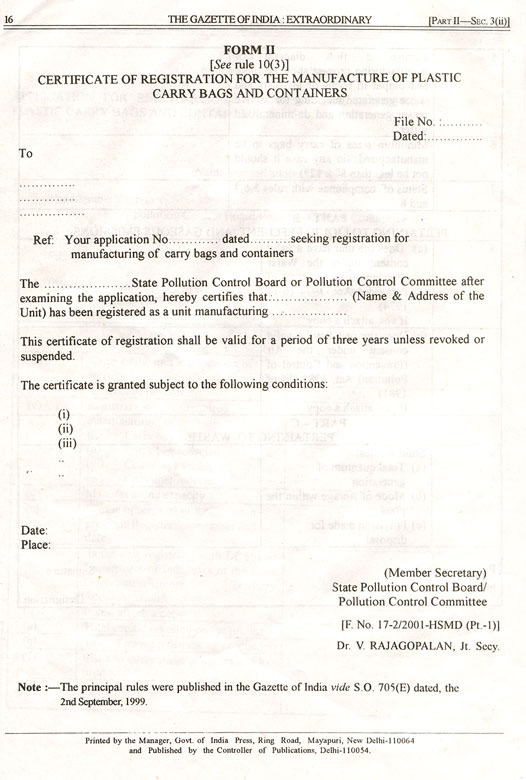
The Recycled Plastics Manufacture and Usage Rules. 1999.
S. 0. 705 (F-).-Whereas draft rules in exercise of the powers conferred by clause (viii) of sub section (2) of section 3 read with section 25 of the Environment (Protection) Act, 1986 (29 of 1986) was published in the Gazette vide S.O. 980 (E) dated 20th November, 1998 entitled Recycled Plastics Usage Rules, 1998 inviting objections from the public within 60 days from the date of the publication of the said notification and whereas all objections received were duly considered;
The Bio-Medical Waste (Management and Handling) Rules,1998
S.O. 630 (E).-Whereas a notification in exercise of the powers conferred by Sections 6, 8 and 25 of the Environment (Protection) Act, 1986 (29 of 1986) was published in the Gazette vide S.O. 746 (E) dated 16 October, 1997 inviting objections from the public within 60 days from the date of the publication of the said notification on the Bio-Medical Waste (Management and Handling) Rules, 1998 and whereas all objections received were duly considered
MINISTRY OF ENVIRONMENT & FORESTS - NOTIFICATION
New Delhi, 20th July, 1998
S.O. 630 (E). – Whereas a notification in exercise of the powers conferred by Sections 6, 8 and 25 of the Environment (Protection) Act, 1986 (29 of 1986) was published in the Gazette vide S.O. 746 (E) dated 16 October, 1997 inviting objections from the public within 60 days from the date of the publication of the said notification on the Bio-Medical Waste (Management and Handling) Rules, 1998 and whereas all objections received were duly considered..
Now, therefore, in exercise of the powers conferred by Sections 6, 8 and 25 of the Environment (Protection) Act, 1986, the Central Government hereby notifies the rules for the management and handling of bio-medical waste.
1. Short Title and Commencement
- These rules may be called the Bio-Medical Waste (Management and Handling) Rules, 1998.
- They shall come into force on the date of their publication in the official Gazette.
2. Application
These rules apply to all persons who generate, collect, receive, store, transport, treat, dispose, or handle bio-medical waste in any form.
3. Definitions
In these rules, unless the context otherwise requires:
- “Act” means the Environment (Protection) Act, 1986 (29 of 1986);
- “Animal House” means a place where animals are reared/kept for experiments or testing purposes;
- “Authorisation” means permission granted by the prescribed authority for the generation, collection, reception, storage, transportation, treatment, disposal and/or any other form of handling of bio-medical waste in accordance with these rules and any guidelines issued by the Central Government.
- “Authorised person” means an occupier or operator authorised by the prescribed authority to generate, collect, receive, store, transport, treat, dispose and/or handle bio-medical waste in accordance with these rules and any guidelines issued by the Central Government;
- “Bio-medical waste” means any waste which is generated during the diagnosis, treatment or immunisation of human beings or animals or in research activities pertaining thereto or in the production or testing of biologicals, and including categories mentioned in Schedule I;
- “Biologicals” means any preparation made from organisms or micro-organisms or product of metabolism and biochemical reactions intended for use in the diagnosis, immunisation or the treatment of human beings or animals or in research activities pertaining thereto;
- “Bio-medical waste treatment facility” means any facility wherein treatment, disposal of bio-medical waste or processes incidental to such treatment or disposal is carried out;
- “Occupier” in relation to any institution generating bio-medical waste, which includes a hospital, nursing home, clinic dispensary, veterinary institution, animal house, pathological laboratory, blood bank by whatever name called, means a person who has control over that institution and/or its premises;
- “Operator of a bio-medical waste facility” means a person who owns or controls or operates a facility for the collection, reception, storage, transport, treatment, disposal or any other form of handling of bio-medical waste;
- “Schedule” means schedule appended to these rules;
4. Duty of Occupier
It shall be the duty of every occupier of an institution generating bio-medical waste which includes a hospital, nursing home, clinic, dispensary, veterinary institution, animal house, pathological laboratory, blood bank by whatever name called to take all steps to ensure that such waste is handled without any adverse effect to human health and the environment.
5. Treatment and Disposal
- Bio-medical waste shall be treated and disposed of in accordance with Schedule I, and in compliance with the standards prescribed in Schedule V.
- Every occupier, where required, shall set up in accordance with the time-schedule in Schedule VI, requisite bio-medical waste treatment facilities like incinerator, autoclave, microwave system for the treatment of waste, or, ensure requisite treatment of waste at a common waste treatment facility or any other waste treatment facility.
6. Segregation, Packaging, Transportation and Storage
- Bio-medical waste shall not be mixed with other wastes.
- Bio-medical waste shall be segregated into containers/bags at the point of generation in accordance with Schedule II prior to its storage, transportation, treatment and disposal. The containers shall be labeled according to Schedule III.
- If a container is transported from the premises where bio-medical waste is generated to any waste treatment facility outside the premises, the container shall, apart from the label prescribed in Schedule III, also carry information prescribed in Schedule IV.
- Notwithstanding anything contained in the Motor Vehicles Act, 1988, or rules thereunder, untreated bio-medical waste shall be transported only in such vehicle as may be authorised for the purpose by the competent authority as specified by the government.
- No untreated bio-medical waste shall be kept stored beyond a period of 48 hours:
Provided that if for any reason it becomes necessary to store the waste beyond such period, the authorised person must take permission of the prescribed authority and take measures to ensure that the waste does not adversely affect human health and the environment.
7. Prescribed Authority
- The Government of every State and Union Territory shall establish a prescribed authority with such members as may be specified for granting authorisation and implementing these rules. If the prescribed authority comprises of more than one member, a chairperson for the authority shall be designated.
- The prescribed authority for the State or Union Territory shall be appointed within one month of the coming into force of these rules.
- The prescribed authority shall function under the supervision and control of the respective Government of the State or Union Territory.
- The prescribed authority shall on receipt of Form 1 make such enquiry as it deems fit and if it is satisfied that the applicant possesses the necessary capacity to handle bio-medical waste in accordance with these rules, grant or renew an authorisation as the case may be.
- An authorisation shall be granted for a period of three years, including an initial trial period of one year from the date of issue. Thereafter, an application shall be made by the occupier/operator for renewal. All such subsequent authorisation shall be for a period of three years. A provisional authorisation will be granted for the trial period, to enable the occupier/operator to demonstrate the capacity of the facility.
- The prescribed authority may after giving reasonable opportunity of being heard to the applicant and for reasons thereof to be recorded in writing, refuse to grant or renew authorisation.
- Every application for authorisation shall be disposed of by the prescribed authority within ninety days from the date of receipt of the application.
- The prescribed authority may cancel or suspend an authorisation, if for reasons, to be recorded in writing, the occupier/operator has failed to comply with any provision of the Act or these rules:
Provided that no authorisation shall be cancelled or suspended without giving a reasonable opportunity to the occupier/operator of being heard.
8. Authorisation
- Every occupier of an institution generating, collecting, receiving, storing, transporting, treating, disposing and/or handling bio-medical waste in any other manner, except such occupier of clinics, dispensaries, pathological laboratories, blood banks providing treatment/service to less than 1000 (one thousand) patients per month, shall make an application in Form 1 to the prescribed authority for grant of authorisation.
- Every operator of a bio-medical waste facility shall make an application in Form 1 to the prescribed authority for grant of authorisation.
- Every application in Form 1 for grant of authorisation shall be accompanied by a fee as may be prescribed by the Government of the State or Union Territory.
9. Advisory Committee
The Government of every State/Union Territory shall constitute an advisory committee. The committee will include experts in the field of medical and health, animal husbandry and veterinary sciences, environmental management, municipal administration, and any other related department or organisation including non-governmental organisations. The State Pollution Control Board/Pollution Control Committee shall be represented. As and when required, the committee shall advise the Government of the State/Union Territory and the prescribed authority about matters related to the implementation of these rules.
10. Annual Report
Every occupier/operator shall submit an annual report to the prescribed authority in Form II by 31 January every year, to include information about the categories and quantities of bio-medical wastes handled during the preceding year. The prescribed authority shall send this information in a compiled form to the Central Pollution Control Board by 31 March every year.
11. Maintenance of Records
- Every authorised person shall maintain records related to the generation, collection, reception, storage, transportation, treatment, disposal and/or any form of handling of bio-medical waste in accordance with these rules and any guidelines issued.
- All records shall be subject to inspection and verification by the prescribed authority at any time.
12. Accident Reporting
When any accident occurs at any institution or facility or any other site where bio-medical waste is handled or during transportation of such waste, the authorised person shall report the accident in Form III to the prescribed authority forthwith.
13. Appeal
Any person aggrieved by an order made by the prescribed authority under these rules may, within thirty days from the date on which the order is communicated to him, prefer an appeal to such authority as the Government of State/Union Territory may think fit to constitute:
Provided that the authority may entertain the appeal after the expiry of the said period of thirty days if it is satisfied that the appellant was prevented by sufficient cause from filing the appeal in time.
SCHEDULE I
(See Rule 5)
CATEGORIES OF BIO-MEDICAL WASTE
| Option | Waste Category | Treatment & Disposal |
|---|---|---|
| Category No. 1 |
Human Anatomical Waste (human tissues, organs, body parts) |
Incineration@ / Deep burial* |
| Category No. 2 |
Animal Waste (animal tissues, organs, body parts, carcasses, bleeding parts, fluid, blood and experimental animals used in research, waste generated by veterinary hospitals/colleges, discharge from hospitals, animal houses) |
Incineration@ / Deep burial* |
| Category No. 3 |
Microbiology & Biotechnology Waste (wastes from laboratory cultures, stocks or specimens of microorganisms, live or attenuated vaccines, human and animal cell culture used in research and infectious agents from research and industrial laboratories, wastes from production of biologicals, toxins, dishes and devices used for transfer of cultures) |
Local autoclaving / microwaving / incineration@ |
| Category No. 4 |
Waste Sharps (needles, syringes, scalpels, blades, glass, etc. that may cause puncture and cuts. This includes both used and unused sharps) |
Disinfection (chemical treatment@) / autoclaving / microwaving and mutilation / shredding |
| Category No. 5 |
Discarded Medicines and Cytotoxic Drugs (wastes comprising of outdated, contaminated and discarded medicines) |
Incineration@ / destruction and drugs disposal in secured landfills |
| Category No. 6 |
Solid Waste (items contaminated with blood, and body fluids including cotton, dressings, soiled plaster casts, linens, beddings, other material contaminated with blood) |
Incineration@ / autoclaving / microwaving |
| Category No. 7 |
Solid Waste (wastes generated from disposable items other than the waste sharps such as tubings, catheters, intravenous sets, etc.) |
Disinfection by chemical treatment@@ / autoclaving / microwaving and mutilation / shredding## |
| Category No. 8 |
Liquid Waste (waste generated from laboratory and washing, cleaning, housekeeping and disinfecting activities) |
Disinfection by chemical treatment@@ and discharge into drains |
| Category No. 9 |
Incineration Ash (ash from incineration of any bio-medical waste) |
Disposal in municipal landfill |
| Category No. 10 |
Chemical Waste (chemicals used in production of biologicals, chemicals used in disinfection, as insecticides, etc.) |
Chemical treatment@@ and discharge into drains for liquids and secured landfill for solids |
## Multilation/shredding must be such so as to prevent unauthorised reuse.
@ There will be no chemical pretreatment before incineration. Chlorinated plastics shall not be incinerated.
*Deep burial shall be an option available only in towns with population less than five lakhs and in rural areas.
SCHEDULE II
(see Rule 6)
COLOUR CODING AND TYPE OF CONTAINER FOR DISPOSAL OF BIO-MEDICAL WASTES
| Colour Coding | Type of Container & Waste Category | Treatment Options as per Schedule I |
|---|---|---|
| Yellow |
Plastic bag Categories: Cat. 1, Cat. 2, Cat. 3, Cat. 6 |
Incineration / Deep burial |
| Red |
Disinfected container / plastic bag Categories: Cat. 3, Cat. 6, Cat. 7 |
Autoclaving / Microwaving / Chemical Treatment |
| Blue / White (Translucent) |
Plastic bag / puncture proof container Categories: Cat. 4, Cat. 7 |
Autoclaving / Microwaving / Chemical Treatment and Destruction / Shredding |
| Black |
Plastic bag Categories: Cat. 5, Cat. 9, Cat. 10 (solid) |
Disposal in secured landfill |
Notes:
1. Colour coding of waste categories with multiple treatment options as defined in Schedule I, shall be selected depending on treatment option chosen, which shall be as specified in Schedule I.
2. Waste collection bags for waste types needing incineration shall not be made of chlorinated plastics.
3. Categories 8 and 10 (liquid) do not require containers / bags.
4. Category 3 if disinfected locally need not be put in containers / bags.
SCHEDULE III
(see Rule 6)
LABEL FOR BIO-MEDICAL WASTE CONTAINERS/BAGS
HANDLE WITH CARE
Note : Lable shall be non-washable and prominently visible.
SCHEDULE IV
(see Rule 6)
LABEL FOR TRANSPORT OF BIO-MEDICAL WASTE CONTAINERS/BAGS
Day ............  Month ..............
				Year ...........
				Date of generation ...................

Waste category No ........
Waste class
Waste description

Sender's Name & Address 			Receiver's Name & Address
Phone No ........ 				Phone No ...............
Telex No .... 					Telex No ...............
Fax No ............... 				Fax No .................
Contact Person ........ 			Contact Person .........
In case of emergency please contact
Name & Address :

Phone No.
Note :
Label shall be non-washable and prominently visible.
SCHEDULE V
STANDARDS FOR TREATMENT AND DISPOSAL OF BIO-MEDICAL WASTES
STANDARDS FOR INCINERATORS:
All incinerators shall meet the following operating and emission standards
A. Operating Standards
1. Combustion efficiency (CE) shall be at least 99.00%.
2. The Combustion efficiency is computed as follows:
		   %C02
	C.E. =  ------------  X 100
		%C02 + % CO
3. The temperature of the primary chamber shall be 800 ± 50 deg. C°.
4. The secondary chamber gas residence time shall be at least I (one) second at 1050 ± 50 C°, with minimum 3% Oxygen in the stack gas.
B. Emission Standards
Parameters				Concentration mg/Nm3 at (12% CO2 correction)

(1) Particulate matter 			150
(2) Nitrogen Oxides 			450
(3) HCI 				50
(4) Minimum stack height shall be 30 metres above ground
(5) Volatile organic compounds in ash shall not be more than 0.01%
Note :
• Suitably designed pollution control devices should be installed/retrofitted with the incinerator to achieve the above emission limits, if necessary.
• Wastes to be incinerated shall not be chemically treated with any chlorinated disinfectants.
• Chlorinated plastics shall not be incinerated.
• Toxic metals in incineration ash shall be limited within the regulatory quantities as defined under the Hazardous Waste (Management and Handling Rules,) 1989.
• Only low sulphur fuel like L.D.0dLS.H.S.1Diesel shall be used as fuel in the incinerator.
STANDARDS FOR WASTE AUTOCLAVING:
The autoclave should be dedicated for the purposes of disinfecting and treating bio-medical waste,
(I) When operating a gravity flow autoclave, medical waste shall be subjected to :
(i) a temperature of not less than 121 C’ and pressure of 15 pounds per square inch (psi) for an autoclave residence time of not less than 60 minutes; or
(ii) a temperature of not less than 135 C° and a pressure of 31 psi for an autoclave residence time of not less than 45 minutes; or
(iii) a temperature of not less than 149 C° and a pressure of 52 psi for an autoclave residence time of not less than 30 minutes.
(II) When operating a vacuum autoclave, medical waste shall be subjected to a minimum of one pre-vacuum pulse to purge the autoclave of all air. The waste shall be subjected to the following:
(i) a temperature of not less than 121 C° and pressure of 15 psi per an autoclave residence time of not less than 45 minutes; or
(ii) a temperature of not less than 135 C° and a pressure of 31 psi for an autoclave residence time of not less than 30 minutes;
(III) Medical waste shall not be considered properly treated unless the time, temperature and pressure indicators indicate that the required time, temperature and pressure were reached during the autoclave process. If for any reasons, time temperature or pressure indicator indicates that the required temperature, pressure or residence time was not reached, the entire load of medical waste must be autoclaved again until the proper temperature, pressure and residence time were achieved.
(IV) Recording of operational parameters
Each autoclave shall have graphic or computer recording devices which will automatically and continuously monitor and record dates, time of day, load identification number and operating parameters throughout the entire length of the autoclave cycle.
(V) Validation test
Spore testing :
The autoclave should completely and consistently kill the approved biological indicator at the maximum design capacity of each autoclave unit. Biological indicator for autoclave shall be Bacillus stearothermophilus spores using vials or spore Strips; with at least 1X10⁴ spores per millilitre. Under no circumstances will an autoclave have minimum operating parameters less than a residence time of 30 minutes, regardless of temperature and pressure, a temperature less than 121 C° or a pressure less than 15 psi.
(VI) Routine Test
A chemical indicator strip/tape the changes colour when a certain temperature is reached can be used to verify that a specific temperature has been achieved. It may be necessary to use more than one strip over the waste package at different location to ensure that the inner content of the package has been adequately autoclaved
STANDARD FOR LIQUID WASTE:
The effluent generated from the hospital should conform to the following limits
	PARAMETERS  		PERMISSIBLE LIMITS

	PH    			63-9.0
	Susponded solids  	100 mg/l
	Oil and grease   	10 mg/l
	BOD    			30 mg/l
	COD    			250 mg/l
	Bio-assay test   	90% survival of fish after 96 hours in 100% effluent.
these limits are applicable to those, hospitals which are either connected with sewers without terminal sewage treatment plant or not connected to public sewers. For discharge into public sewers with terminal facilities, the general standards as notified under the Environment (Protection) Act, 1986 shall be applicable.
STANDARDS OF MICROWAVING
1 Microwave treatment shall not be used for cytotoxic, hazardous or radioactive wastes, contaminated animal car casses, body parts and large metal items.
2. The microwave system shall comply with the efficacy test/routine tests and a performance guarantee may be provided by the supplier before operation of the limit.
3. The microwave should completely and consistently kill the bacteria and other pathogenic organisms that is ensured by approved biological indicator at the maximum design capacity of each microwave unit. Biological indicators for microwave shall be Bacillus Subtilis spores using vials or spore strips with at least 1 x 101 spores per milliliter.
STANDARDS FOR DEEP BURIAL
1. A pit or trench should he dug about 2 meters deep. It should be half filled with waste, then covered with lime within 50 cm of the surface, before filling the rest of the pit with soil.
2. It must be ensured that animals do not have any access to burial sites. Covers of galvanised iron/wire meshes may be used.
3. On each occasion, when wastes are added to the pit, a layer of 10 em of soil shall be added to cover the wastes.
4. Burial must be performed under close and dedicated supervision.
5. The deep burial site should be relatively impermeable and no shallow well should be close to the site.
6. The pits should be distant from habitation, and sited so as to ensure that no contamination occurs of any surface water or ground water. The area should not be prone to flooding or erosion.
7. The location of the deep burial site will be authorised by the prescribed authority.
8. The institution shall maintain a record of all pits for deep burial.
SCHEDULE VI
SCHEDULE FOR WASTE TREATMENT FACILITIES LIKE INCINERATOR/ AUTOCLAVE/ MICROWAVE SYSTEM
| Category | Description | Deadline |
|---|---|---|
| A | Hospitals and nursing homes in towns with population of 30 lakhs and above | By 31st December, 1999 or earlier |
| B | Hospitals and nursing homes in towns with population of below 30 lakhs, with 500 beds and above | By 31st December, 1999 or earlier |
| Hospitals and nursing homes in towns with population of below 30 lakhs, with 200 beds and above but less than 500 beds | By 31st December, 2000 or earlier | |
| Hospitals and nursing homes in towns with population of below 30 lakhs, with 50 beds and above but less than 200 beds | By 31st December, 2001 or earlier | |
| Hospitals and nursing homes in towns with population of below 30 lakhs, with less than 50 beds | By 31st December, 2002 or earlier | |
| C | All other institutions generating bio-medical waste not included in A and B above | By 31st December, 2002 or earlier |
FORM I
(see rule 8)
APPLICATION FOR AUTHORISATION
(To be submitted in duplicate.)
Application for Bio-Medical Waste Authorisation
To
The Prescribed Authority
(Name of the State Govt/UT Administration)
Address.
1. Particulars of Applicant
(i) Name of the Applicant (In block letters & in full): ________________________
(ii) Name of the Institution: ________________________
Address: ________________________
Tel No.: ________________________
Fax No.: ________________________
Telex No.: ________________________
2. Activity for which authorisation is sought:
- Generation
- Collection
- Reception
- Storage
- Transportation
- Treatment
- Disposal
- Any other form of handling
3. Please state whether applying for fresh authorisation or for renewal:
(In case of renewal, previous authorisation number and date): ________________________
4.
(i) Address of the institution handling bio-medical wastes: ________________________
(ii) Address of the place of the treatment facility: ________________________
(iii) Address of the place of disposal of the waste: ________________________
5.
(i) Mode of transportation (if any) of bio-medical waste: ________________________
(ii) Mode(s) of treatment: ________________________
6. Brief description of method of treatment and disposal (attach details):
________________________________________________________________
7.
(i) Category (see Schedule 1) of waste to be handled: ________________________
(ii) Quantity of waste (category-wise) to be handled per month: ________________________
8. Declaration
I do hereby declare that the statements made and information given above are true to the best of my knowledge and belief and that I have not concealed any information.
I do also hereby undertake to provide any further information sought by the prescribed authority in relation to these rules and to fulfill any conditions stipulated by the prescribed authority.
Date: ________________________
Place: ________________________
Signature of the Applicant: ________________________
Designation of the Applicant: ________________________
FORM II
(see rule 10)
ANNUALREPORT
Annual Report Form
(To be submitted to the prescribed authority by 31 January every year)
1. Particulars of the applicant:
(i) Name of the authorised person (occupier/operator): ________________________
(ii) Name of the institution: ________________________
Address: ________________________
Tel. No.: ________________________
Telex No.: ________________________
Fax No.: ________________________
2. Categories of waste generated and quantity on a monthly average basis:
________________________________________________________________
3. Brief details of the treatment facility:
________________________________________________________________
In case of off-site facility:
(i) Name of the operator: ________________________
(ii) Name and address of the facility: ________________________
Tel. No.: ________________________
Telex No.: ________________________
Fax No.: ________________________
4. Category-wise quantity of waste treated:
5. Mode of treatment with details:
6. Any other information:
7. Certification
Certified that the above report is for the period from ______________ to ______________
Date: ________________________
Place: ________________________
Signature: ________________________
Designation: ________________________
FORM III
(see Rule 12)
ACCIDENT REPORTING
Accident Reporting Form
1. Date and time of accident:
2. Sequence of events leading to accident:
3. The waste involved in accident:
4. Assessment of the effects of the accident on human health and the environment:
5. Emergency measures taken:
6. Steps taken to alleviate the effects of the accident:
7. Steps taken to prevent the recurrence of such an accident:
Date: ________________________
Place: ________________________
Signature: ________________________
Designation: ________________________
[F.No.23-2/96-HSMD]
VIJAY SHARMA, Jt.Secy.
Procedure relating to import of Plastic Waste/Scrap.
Attention is invited to Public Notice No.392 (PN)/92-97 dated 1.1.1997 according to which import of Plastic Waste/Scrap (except PET Bottle Waste/Scarp) and animal dung or animal excreta shall not, be permitted, except against a license. Applicants while submitting the application as per provisions laid down in para 1(iv) of the said public notice shall adhere to all guidelines / conditions of this public notice
Extraordinary rajpatra, Himachal Pradesh, 22 Dec., 1995
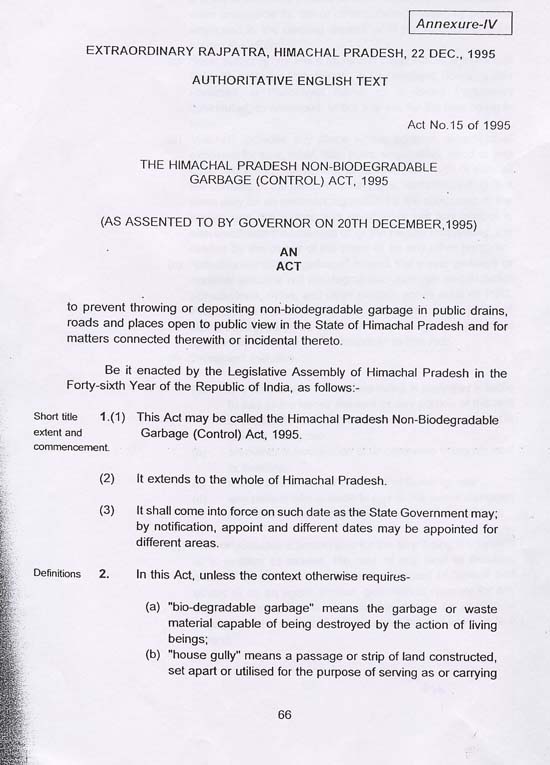
The Himachal pradesh Non-Biodegradable Garbage(Control) Act, 1995
Act No. 15 of 1995 – An Act to prevent throwing or depositing non-biodegradable garbage in public drains, roads and place open to public view in the State of Himachal Pradesh and for matters connected therewith or incidental thereto
The Himachal pradesh Non-Biodegradable Garbage(Control) Act, 1995 - Act No. 15 of 1995
The Environment (Protection) Act,1986, amended 1991
No. 29 OF 1986 – An Act to provide for the protection and improvement of environment and for matters connected there with:
WHEREAS the decisions were taken at the United NationsConference on the Human Environment held at Stockholm in June, 1972, in which India participated, to take appropriate steps for the protection and improvement of human environment;
AND WHEREAS it is considered necessary further to implement the decisions aforesaid in so far as they relate to the protection and improvement of environment and the prevention of hazards to human beings, other living creatures, plants and property
THE ENVIRONMENT (PROTECTION) ACT, 1986 No. 29 OF 1986
An Act to provide for the protection and improvement of environment and for matters connected there with:
WHEREAS the decisions were taken at the United NationsConference on the Human Environment held at Stockholm in June, 1972, in which India participated, to take appropriate steps for the protection and improvement of human environment;
AND WHEREAS it is considered necessary further to implement the decisions aforesaid in so far as they relate to the protection and improvement of environment and the prevention of hazards to human beings, other living creatures, plants and property;
BE it enacted by Parliament in the Thirty-seventh Year of the Republic of India as follows:-
CHAPTER I
PRELIMINARY
1.SHORT TITLE, EXTEND AND COMMENCEMENT
(1) This Act may be called the Environment (Protection) Act, 1986.
(2) It extends to the whole of India.
(3) It shall come into force on such date as the Central Government may, by notification in the Official Gazette, appoint and different dates may be appointed for different provisions of this Act and for different areas.1
2.DEFINITIONS
In this Act, unless the context otherwise requires,–
(a) “environment” includes water, air and land and the inter- relationship which exists among and between water, air and land, and human beings, other living creatures, plants, micro-organism and property;
(b) “environmental pollutant” means any solid, liquid or gaseous substance present in such concentration as may be, or tend to be, injurious to environment;
(c) “environmental pollution” means the presence in the environment of any environmental pollutant;
(d) “handling”, in relation to any substance, means the manufacture, processing, treatment, package, storage, transportation, use, collection, destruction, conversion, offering for sale, transfer or the like of such substance;
(e) “hazardous substance” means any substance or preparation which, by reason of its chemical or physico-chemical properties or handling, is liable to cause harm to human beings, other living creatures, plant, micro-organism, property or the environment;
(f) “occupier”, in relation to any factory or premises, means a person who has, control over the affairs of the factory or the premises and includes in relation to any substance, the person in possession of the substance;
(g) “prescribed” means prescribed by rules made under this Act.
CHAPTER II
GENERAL POWERS OF THE CENTRAL GOVERNMENT
3. POWER OF CENTRAL GOVERNMENT TO TAKE MEASURES TO PROTECT AND IMPROVE ENVIRONMENT
(1) Subject to the provisions of this Act, the Central Government, shall have the power to take all such measures as it deems necessary or expedient for the purpose of protecting and improving the quality of the environment and preventing controlling and abating environmental pollution.
(2) In particular, and without prejudice to the generality of the provisions of sub-section (1), such measures may include measures with respect to all or any of the following matters, namely:–
(i) co-ordination of actions by the State Governments, officers and other authorities–
(a) under this Act, or the rules made thereunder, or
(b) under any other law for the time being in force which is relatable to the objects of this Act;
(ii) planning and execution of a nation-wide programme for the prevention, control and abatement of environmental pollution;
(iii) laying down standards for the quality of environment in its various aspects;
(iv) laying down standards for emission or discharge of environmental pollutants from various sources whatsoever:
Provided that different standards for emission or discharge may be laid down under this clause from different sources having regard to the quality or composition of the emission or discharge of environmental pollutants from such sources;
(v) restriction of areas in which any industries, operations or processes or class of industries, operations or processes shall not be carried out or shall be carried out subject to certain safeguards;
(vi) laying down procedures and safeguards for the prevention of accidents which may cause environmental pollution and remedial measures for such accidents;
(vii) laying down procedures and safeguards for the handling of hazardous substances;
(viii) examination of such manufacturing processes, materials and substances as are likely to cause environmental pollution;
(ix) carrying out and sponsoring investigations and research relating to problems of environmental pollution;
(x) inspection of any premises, plant, equipment, machinery, manufacturing or other processes, materials or substances and giving, by order, of such directions to such authorities, officers or persons as it may consider necessary to take steps for the prevention, control and abatement of environmental pollution;
(xi) establishment or recognition of environmental laboratories and institutes to carry out the functions entrusted to such environmental laboratories and institutes under this Act;
(xii) collection and dissemination of information in respect of matters relating to environmental pollution;
(xiii) preparation of manuals, codes or guides relating to the prevention, control and abatement of environmental pollution;
(xiv) such other matters as the Central Government deems necessary or expedient for the purpose of securing the effective implementation of the provisions of this Act.
(3) The Central Government may, if it considers it necessary or expedient so to do for the purpose of this Act, by order, published in the Official Gazette, constitute an authority or authorities by such name or names as may be specified in the order for the purpose of exercising and performing such of the powers and functions (including the power to issue directions under section 5) of the Central Government under this Act and for taking measures with respect to such of the matters referred to in sub-section (2) as may be mentioned in the order and subject to the supervision and control of the Central Government and the provisions of such order, such authority or authorities may exercise and powers or perform the functions or take the measures so mentioned in the order as if such authority or authorities had been empowered by this Act to exercise those powers or perform those functions or take such measures.
4. APPOINTMENT OF OFFICERS AND THEIR POWERS AND FUNCTIONS
(1) Without prejudice to the provisions of sub-section (3) of section 3, the Central Government may appoint officers with such designation as it thinks fit for the purposes of this Act and may entrust to them such of the powers and functions under this Act as it may deem fit.
(2) The officers appointed under sub-section (1) shall be subject to the general control and direction of the Central Government or, if so directed by that Government, also of the authority or authorities, if any, constituted under sub- section (3) of section 3 or of any other authority or officer.
5. POWER TO GIVE DIRECTIONS
Notwithstanding anything contained in any other law but subject to the provisions of this Act, the Central Government may, in the exercise of its powers and performance of its functions under this Act, issue directions in writing to any person, officer or any authority and such person, officer or authority shall be bound to comply with such directions.3
Explanation–For the avoidance of doubts, it is hereby declared that the power to issue directions under this section includes the power to direct–
(a) the closure, prohibition or regulation of any industry, operation or process; or
(b) stoppage or regulation of the supply of electricity or water or any other service.
6. RULES TO REGULATE ENVIRONMENTAL POLLUTION
(1) The Central Government may, by notification in the Official Gazette, make rules in respect of all or any of the matters referred to in section 3.
(2) In particular, and without prejudice to the generality of the foregoing power, such rules may provide for all or any of the following matters, namely:–
(a) the standards of quality of air, water or soil for various areas and purposes;4
(b) the maximum allowable limits of concentration of various environmental pollutants (including noise) for different areas;
(c) the procedures and safeguards for the handling of hazardous substances;5
(d) the prohibition and restrictions on the handling of hazardous substances in different areas;6
(e) the prohibition and restriction on the location of industries and the carrying on process and operations in different areas;7
(f) the procedures and safeguards for the prevention of accidents which may cause environmental pollution and for providing for remedial measures for such accidents.8
CHAPTER III
PREVENTION, CONTROL, AND ABATEMENT OF ENVIRONMENTAL POLLUTION
7. PERSONS CARRYING ON INDUSTRY OPERATION, ETC., NOT TO ALLOW EMISSION OR DISCHARGE OF ENVIRONMENTAL POLLUTANTS IN EXCESS OF THE STANDARDS
No person carrying on any industry, operation or process shall discharge or emit or permit to be discharged or emitted any environmental pollutants in excess of such standards as may be prescribed.9
8. PERSONS HANDLING HAZARDOUS SUBSTANCES TO COMPLY WITH PROCEDURAL SAFEGUARDS
No person shall handle or cause to be handled any hazardous substance except in accordance with such procedure and after complying with such safeguards as may be prescribed.10
9. FURNISHING OF INFORMATION TO AUTHORITIES AND AGENCIES IN CERTAIN CASES
(1) Where the discharge of any environmental pollutant in excess of the prescribed standards occurs or is apprehended to occur due to any accident or other unforeseen act or event, the person responsible for such discharge and the person in charge of the place at which such discharge occurs or is apprehended to occur shall be bound to prevent or mitigate the environmental pollution caused as a result of such discharge and shall also forthwith–
(a) intimate the fact of such occurrence or apprehension of such occurrence; and
(b) be bound, if called upon, to render all assistance,
to such authorities or agencies as may be prescribed.11
(2) On receipt of information with respect to the fact or apprehension on any occurrence of the nature referred to in sub-section (1), whether through intimation under that sub-section or otherwise, the authorities or agencies referred to in sub-section (1) shall, as early as practicable, cause such remedial measures to be taken as necessary to prevent or mitigate the environmental pollution.
(3) The expenses, if any, incurred by any authority or agency with respect to the remedial measures referred to in sub-section (2), together with interest (at such reasonable rate as the Government may, by order, fix) from the date when a demand for the expenses is made until it is paid, may be recovered by such authority or agency from the person concerned as arrears of land revenue or of public demand.
10. POWERS OF ENTRY AND INSPECTION
(1) Subject to the provisions of this section, any person empowered by the Central Government in this behalf12 shall have a right to enter, at all reasonable times with such assistance as he considers necessary, any place–
(a) for the purpose of performing any of the functions of the Central Government entrusted to him;
(b) for the purpose of determining whether and if so in what manner, any such functions are to be performed or whether any provisions of this Act or the rules made thereunder orany notice, order, direction or authorisation served, made, given or granted under this Act is being or has been complied with;
(c) for the purpose of examining and testing any equipment, industrial plant, record, register, document or any other material object or for conducting a search of any building in which he has reason to believe that an offence under this Act or the rules made thereunder has been or is being or is about to be committed and for seizing any such equipment, industrial plant, record, register, document or other material object if he has reason to believe that it may furnish evidence of the commission of an offence punishable under this Act or the rules made thereunder or that such seizure is necessary to prevent or mitigate environmental pollution.
(2) Every person carrying on any industry, operation or process of handling any hazardous substance shall be bound to render all assistance to the person empowered by the Central Government under sub-section (1) for carrying out the functions under that sub-section and if he fails to do so without any reasonable cause or excuse, he shall be guilty of an offence under this Act.
(3) If any person wilfully delays or obstructs any persons empowered by the Central Government under sub-section (1) in the performance of his functions, he shall be guilty of an offence under this Act.
(4) The provisions of the Code of Criminal Procedure, 1973, or, in relation to the State of Jammu and Kashmir, or an area in which that Code is not in force, the provisions of any corresponding law in force in that State or area shall, so far as may be, apply to any search or seizures under this section as they apply to any search or seizure made under the authority of a warrant issued under section 94 of the said Code or as the case may be, under the corresponding provision of the said law.
11. POWER TO TAKE SAMPLE AND PROCEDURE TO BE FOLLOWED IN CONNECTION THEREWITH
(1) The Central Government or any officer empowered by it in this behalf,13 shall have power to take, for the purpose of analysis, samples of air, water, soil or other substance from any factory, premises or other place in such manner as may be prescribed.14
(2) The result of any analysis of a sample taken under sub-section (1) shall not be admissible in evidence in any legal proceeding unless the provisions of sub-sections (3) and (4) are complied with.
(3) Subject to the provisions of sub-section (4), the person taking the sample under sub-section (1) shall–
(a) serve on the occupier or his agent or person in charge of the place, a notice, then and there, in such form as may be prescribed, of his intention to have it so analysed;
(b) in the presence of the occupier of his agent or person, collect a sample for analysis;
(c) cause the sample to be placed in a container or containers which shall be marked and sealed and shall also be signed both by the person taking the sample and the occupier or his agent or person;
(d) send without delay, the container or the containers to the laboratory established or recognised by the Central Government under section 12.
(4) When a sample is taken for analysis under sub-section (1) and the person taking the sample serves on the occupier or his agent or person, a notice under clause (a) of sub-section (3), then,–
(a) in a case where the occupier, his agent or person wilfully absents himself, the person taking the sample shall collect the sample for analysis to be placed in a container or containers which shall be marked and sealed and shall also be signed by the person taking the sample, and
(b) in a case where the occupier or his agent or person present at the time of taking the sample refuses to sign the marked and sealed container or containers of the sample as required under clause (c) of sub-section (3), the marked and sealed container or containers shall be signed by the person taking the samples, and the container or containers shall be sent without delay by the person taking the sample for analysis to the laboratory established or recognised under section 12 and such person shall inform the Government Analyst appointed or recognised under section 12 in writing, about the wilfull absence of the occupier or his agent or person, or, as the case may be, his refusal to sign the container or containers.
12.ENVIRONMENTAL LABORATORIES
(1) The Central Government15 may, by notification in the Official Gazette,–
(a) establish one or more environmental laboratories;
(b) recognise one or more laboratories or institutes as environmental laboratories to carry out the functions entrusted to an environmental laboratory under this Act.16
(2) The Central Government may, by notification in the Official Gazette, make rules specifying–
(a) the functions of the environmental laboratory;17
(b) the procedure for the submission to the said laboratory of samples of air, water, soil or other substance for analysis or tests, the form of the laboratory report thereon and the fees payable for such report;18
(c) such other matters as may be necessary or expedient to enable that laboratory to carry out its functions.
13. GOVERNMENT ANALYSTS
The Central Government may by notification in the Official Gazette, appoint or recognise such persons as it thinks fit and having the prescribed qualifications19 to be Government Analysts for the purpose of analysis of samples of air, water, soil or other substance sent for analysis to any environmental laboratory established or recognised under sub-section (1) of section 12.
14. REPORTS OF GOVERNMENT ANALYSTS
Any document purporting to be a report signed by a Government analyst may be used as evidence of the facts stated therein in any proceeding under this Act.
15. PENALTY FOR CONTRAVENTION OF THE PROVISIONS OF THE ACT AND THE RULES, ORDERS AND DIRECTIONS
(1) Whoever fails to comply with or contravenes any of the provisions of this Act, or the rules made or orders or directions issued thereunder, shall, in respect of each such failure or contravention, be punishable with imprisonment for a term which may extend to five years with fine which may extend to one lakh rupees, or with both, and in case the failure or contravention continues, with additional fine which may extend to five thousand rupees for every day during which such failure or contravention continues after the conviction for the first such failure or contravention.
(2) If the failure or contravention referred to in sub-section (1) continues beyond a period of one year after the date of conviction, the offender shall be punishable with imprisonment for a term which may extend to seven years.
16. OFFENCES BY COMPANIES
(1) Where any offence under this Act has been committed by a company, every person who, at the time the offence was committed, was directly in charge of, and was responsible to, the company for the conduct of the business of the company, as well as the company, shall be deemed to be guilty of the offence and shall be liable to be proceeded against and punished accordingly:
Provided that nothing contained in this sub-section shall render any such person liable to any punishment provided in this Act, if he proves that the offence was committed without his knowledge or that he exercised all due diligence to prevent the commission of such offence.
(2) Notwithstanding anything contained in sub-section (1), where an offence under this Act has been committed by a company and it is proved that the offence has been committed with the consent or connivance of, or is attributable to any neglect on the part of, any director, manager, secretary or other officer of the company, such director, manager, secretary or other officer shall also deemed to be guilty of that offence and shall be liable to be proceeded against and punished accordingly.
Explanation–For the purpose of this section,–
(a) “company” means any body corporate and includes a firm or other association of individuals;
(b) “director”, in relation to a firm, means a partner in the firm.
17. OFFENCES BY GOVERNMENT DEPARTMENTS
(1) Where an offence under this Act has been committed by any Department of Government, the Head of the Department shall be deemed to be guilty of the offence and shall be liable to be proceeded against and punished accordingly.
Provided that nothing contained in this section shall render such Head of the Department liable to any punishment if he proves that the offence was committed without his knowledge or that he exercise all due diligence to prevent the commission of such offence.
(2) Notwithstanding anything contained in sub-section (1), where an offence under this Act has been committed by a Department of Government and it is proved that the offence has been committed with the consent or connivance of, or is attributable to any neglect on the part of, any officer, other than the Head of the Department, such officer shall also be deemed to be guilty of that offence and shall be liable to be proceeded against and punished accordingly.
CHAPTER IV
MISCELLANEOUS
18. PROTECTION OF ACTION TAKEN IN GOOD FAITH
No suit, prosecution or other legal proceeding shall lie against the Government or any officer or other employee of the Government or any authority constituted under this Act or any member, officer or other employee of such authority in respect of anything which is done or intended to be done in good faith in pursuance of this Act or the rules made or orders or directions issued thereunder.
19. COGNIZANCE OF OFFENCES
No court shall take cognizance of any offence under this Act except on a complaint made by–
(a) the Central Government or any authority or officer authorised in this behalf by that Government,20 or
(b) any person who has given notice of not less than sixty days, in the manner prescribed, of the alleged offence and of his intention to make a complaint, to the Central Government or the authority or officer authorised as aforesaid.
20. INFORMATION, REPORTS OR RETURNS
The Central Government may, in relation to its function under this Act, from time to time, require any person, officer, State Government or other authority to furnish to it or any prescribed authority or officer any reports, returns, statistics, accounts and other information and such person, officer, State Government or other authority shall be bound to do so.
21. MEMBERS, OFFICERS AND EMPLOYEES OF THE AUTHORITY CONSTITUTED UNDER SECTION 3 TO BE PUBLIC SERVANTS
All the members of the authority, constituted, if any, under section 3 and all officers and other employees of such authority when acting or purporting to act in pursuance of any provisions of this Act or the rules made or orders or directions issued thereunder shall be deemed to be public servants within the meaning of section 21 of the Indian Penal Code (45 of 1860).
22. BAR OF JURISDICTION
No civil court shall have jurisdiction to entertain any suit or proceeding in respect of anything done, action taken or order or direction issued by the Central Government or any other authority or officer in pursuance of any power conferred by or in relation to its or his functions under this Act.
23. POWERS TO DELEGATE
Without prejudice to the provisions of sub-section (3) of section 3, the Central Government may, by notification in the Official Gazette, delegate, subject to such conditions and limitations as may be specified in the notifications, such of its powers and functions under this Act [except the powers to constitute an authority under sub-section (3) of section 3 and to make rules under section 25] as it may deem necessary or expedient, to any officer, State Government or other authority.
24. EFFECT OF OTHER LAWS
(1) Subject to the provisions of sub-section (2), the provisions of this Act and the rules or orders made therein shall have effect notwithstanding anything inconsistent therewith contained in any enactment other than this Act.
(2) Where any act or omission constitutes an offence punishable under this Act and also under any other Act then the offender found guilty of such offence shall be liable to be punished under the other Act and not under this Act.
25. POWER TO MAKE RULES
(1) The Central Government may, by notification in the Official Gazette, make rules for carrying out the purposes of this Act.
(2) In particular, and without prejudice to the generality of the foregoing power, such rules may provide for all or any of the following matters, namely–
(a) the standards in excess of which environmental pollutants shall not be discharged or emitted under section 7;21
(b) the procedure in accordance with and the safeguards in compliance with which hazardous substances shall be handled or caused to be handled under section 8;22
(c) the authorities or agencies to which intimation of the fact of occurrence or apprehension of occurrence of the discharge of any environmental pollutant in excess of the prescribed standards shall be given and to whom all assistance shall be bound to be rendered under sub-section (1) of section 9;23
(d) the manner in which samples of air, water, soil or other substance for the purpose of analysis shall be taken under sub-section (1) of section 11;24
(e) the form in which notice of intention to have a sample analysed shall be served under clause (a) of sub section (3) of section 11;25
(f) the functions of the environmental laboratories,26 the procedure for the submission to such laboratories of samples of air, water, soil and other substances for analysis or test;27 the form of laboratory report; the fees payable for such report and other matters to enable such laboratories to carry out their functions under sub-section (2) of section 12;
(g) the qualifications of Government Analyst appointed or recognised for the purpose of analysis of samples of air, water, soil or other substances under section 13;28
(h) the manner in which notice of the offence and of the intention to make a complaint to the Central Government shall be given under clause (b) of section 19;29
(i) the authority of officer to whom any reports, returns, statistics, accounts and other information shall be furnished under section 20;
(j) any other matter which is required to be, or may be, prescribed.
26. RULES MADE UNDER THIS ACT TO BE LAID BEFORE PARLIAMENT
Every rule made under this Act shall be laid, as soon as may be after it is made, before each Hose of Parliament, while it is in session, for a total period of thirty days which may be comprised in one session or in two or more successive sessions, and if, before the expiry of the session immediately following the session or the successive sessions aforesaid, both Houses agree in making any modification in the rule or both Houses agree that the rule should not be made, the rule shall thereafter have effect only in such modified form or be of no effect, as the case may be; so, however, that any such modification or annulment shall be without prejudice to the validity of anything previously done under that rule.
1 It came into force in the whole of India on 19th November, 1986 vide Notification No. G.S.R. 1198(E) dated 12-11-86 published in the Gazette of India No. 525 dated 12-11-86.
2 The Central Government has delegated the powers vested m it under section 5 of the -Act to the State Governments of Andhra Pradesh, Assam, Bihar, Gujarat, Haryana, Himachal Pradesh, Karnatalca, Kerala, Madhya Predesh, Mizoram, Orissa, Rajasthan, Sikkim and Tamil Nadu subject to the condition that the Central Government may revoke such delegation of Powers in respect of all or any one or more of the State Governments or may itself invoke the provisions of section 5 of the Act, if in the opinion of the Central Government such a course of action is necessary in public interest, (Notification No, S.O. 152 (E) dated 10-2-88 published in Gazette No. 54 of the same date). These Powers have been delegated to the following State Governments also on the same terms:
Meghalaya, Punjab and Uttar Pradesh vide Notification No. S.0.389 (E) dated 14-4-88 published in the Gazette No. 205 dated 144-88;
Maharashtra vide Notification No. S.O. 488(E) dated 17-5-88 published in the Gazette No. 255 dated 17-5-88;
Goa and Jammu & Kashmir vide Notification No. S.O. 881 (E~ dated 22-9-88; published in the Gazette No. 749 dated 22.9.88.
West Bengal Manipur vide Notificadon N. S.O. 408 (E) dated 6-6-89; published in the Gazette No. 319 dated 6-6-89;
Tripura vide Notification No. S.O. 479 (E) dated 25-7-91 published in thc Gazene No. 414 dated 25-7-91.
3 For issuing directions see r.4 of Itnviromnent (Protection) Rules, 1986.
4 See r. 3 of Environment (Protection) Rules, 1986 and Schedules thereto.
i. Schedule I lists the standards for emission or discharge of environmental pollutants from the industries, processes or operations and their maximum allowable limits of concentration;
ii. Schedule II lists general standards for discharge of effluents and their maximum limits of concentration allowable;
iii. Schedule III lists ambient air quality standards in respect of noise and its maximum allowable limits; and
iv. Schedule IV lists standards for emission of smoke, vapour etc. from motor vehicles and maximum allowable limits of their emission.
5 See r. 13 of Environment (Protection) Rules, 1986, and
i. Hazardous Wastes (Management and Handling) Rules, 1989;
ii. Manufacture, Storage and Import of Hazardous Chemicals Rules, 1989; and
iii. Rules for the Manufacture, Use, Import, Export and Storage of Hazardous Micro organisms, Genetically-engineered organisms or Cells.
6 Rule 13 SUPRA.
7 See r. 5 of Environment (Protection) Rules, 1986.
8 See r. 12 of Environment (Protection) Rules and Schedule 11, and relevant provisions of Hazardous Wastes (Management and Handling) Rules, Manufacture, Storage and Import of Hazardous Chemicals Rules and Rules for the Manufacture, Use, Import Export and Storage of hazardous Micro-organisms, Genetically Engineered Organisms or Cells.
9 See r. 3 of Environment (Protection) Rules, 1486 and Schedule I.
10 See r. 13 of Environment (Protection) Rules, 1986 and
i. Hazardous Wastes (Management and Handling) Rules, 1989;
ii. Manufacture, Storage and h7lporl of Hazardous Chemicals Rules, 1989; and
iii. Rules for the Manufacture, Use Import, Export and Storage of Hazardous Micro organisms, Genetically Engineered organisms or Cells.
11 For authorities or agencies see r. 12 of Environment (Protection) Rules, 1986 and Schedule
12 The Central Govt. has empowered 60 persons listed in the Table (p. 251) vide S.O. 83 (E) published in the Gazette of India No. 66 dated 16-2-87 and S.O. 63 (E) published in the Gazette of India No. 42 dated 18-1-88.
13 In excercise of powers conferred under sub-section (i) of section 11 the Central Government has empowered 60 officers listed in the Table (p. 254) vide S.O. 84. (E) published in the Gazette No. 66 dated 16-2-87 and S.O. 62(E) published in the Gazette No. 42 dated 18-l-88.
14 For procedure for taking samples see r. 6 of Environment (Protection) Rules, 1986, also.
15 The Central Government has delegated its powers under clause (b) of sub-section (i) of section 12 and section 13 of the Act to the Central Pollution Control Board vide Notification No. S.O. 145 (E) dated 21-2-91 published in the Gazette No. 128 dated 27-2-91.
16 The list of laboratories/institutes recognised as environmental laboratories: and the persons recognised as Govt. Analysts is given in the table (p. 223).
17 See r. 9 of Environment (Protection) Rules, 1986.
18 See r. 8 of Environment (Protection) Rules, 1986.
19 For qualifications of Govt. Analyst see r. 10 of Environment (Protection) Rules, 1986.
20 In exercise of powers conferred under clause (a) of section l9, the Central-Government has authorised the officers and authorities listed in the Table (p. 238) vide S.O. 394 (E) published in the Gazette No. 185 dated 164-87, S.O. 237(E) published in the Gazette No. 171 dated 29-3-89 and S.O. 656(E) dated 21-8-89 published in the Gazette No. 519 dated 21-8-89.
21 See footnote 2 on Page 213.
22 See footnote 3 on Page 213.
23 See footnote I on Page 214.
24 See r.6 of Environment (Protection) Rules, 1986.
25 See r. 7 of Environment (Protection) Rules, 1986.
26 See r. 9 of Environment (Protection) Rules, 1986.
27 For the procedure for submission of samples to laboratories and the form of laboratory report see r. 8 of Environment (Protection) Rules, 1986.
28 See r. 10 of Environment (Protection) Rules, 1986.
29 See r. 11 of Environment (protection) Rules, 1986.
Hazardous Wastes (Management and Handling) Rules, 1989
S.O. 594(E).—In exercise of the powers conferred by sections 6, 8 and 25 of the Environment (Protection) Act, 1986 (29 of 1986), the Central Government hereby makes the following rules, namely :
1. Short title and commencement.
(1) These rules may be called the Hazardous Wastes (Management and Handling) Rules, 1989.
(2) They shall come into force on the date of their publication in the official Gazette
MINISTRY OF ENVIRONMENT & FORESTS
(Department of Environment, Forests and Wildlife)
NOTIFICATION
New Delhi, the 28th July, 1989
S.O. 594(E).—In exercise of the powers conferred by sections 6, 8 and 25 of the Environment (Protection) Act, 1986 (29 of 1986), the Central Government hereby makes the following rules, namely :
1. Short title and commencement.
(1) These rules may be called the Hazardous Wastes (Management and Handling) Rules, 1989.
(2) They shall come into force on the date of their publication in the official Gazette.
2. Application.
These rules shall apply to hazardous wastes as specified in Schedule and shall not apply to-
(a)waste water and exhaust gases as covered under the provisions of the Water (Prevention and Control of Pollution) Act, 1974 (6 of 1974) and the Air (Prevention and Control of Pollution) Act, 1981 (14 of 1981) and rules made thereunder;
(b)wastes arising out of the operation from ships beyond five kilometres as covered under the provisions of the Merchant Shipping Act,. 1958 (\44 of 1958) and the rules made thereunder,
(c) radio-active wastes as covered under the provisions of the Atomic Energy Act, 1962 (33 of 1962) and rules made thereunder,
3. Definitions.
In these rules, unless the context otherwise requires,-
(a) “Act” means the Environment (Protection) Act, 1986 (29 of 1986);
(b) “applicant” means a person or an organisation that applies, in Form 1, for granting of authorisation to perform specific activities connected with handling of hazardous wastes;
(c) “authorisation” means permission for collection, reception, treatment, transport, storage and disposal of hazardous wastes granted by the competent authority in Form 2;’
(d) “authorised person” means a person or an organisation authorised by the competent authority to collect, treat, transport, store or dispose of hazardous wastes in accordance with the guidelines to be issued by the competent authority from time to time;
(e) “export” with its grammatical variation and cognate expression means taking out of India to a place outside India;
(f) “exporter’ means any person under the jurisdiction of the expor.6ng country who exports hazardous wastes and the exporting country itself, who exports hazardous wastes’
(g) “facility” means any location wherein the processes, incidental to the waste generation collection, reception, treatment, storage and disposal are carried out;
(h) “Form” means Form appended to these rules;
(i) “hazardous wastes” means categories of wastes specified in the Schedule;
(j) “hazardous wastes site” means a place for collection, reception, treatment, storage and disposal of hazardous wastes which has been duly approved by the competent authority;
(k) “import” with its grammatical variations and cognate expressions, means bringing into India from a place outside India;
(l) “importer” means an occupier or any person who imports hazardous wastes;
(m) “operator of a facility” means a person who owns or operates a facility for collection. reception, treatment, storage and disposal of hazardous wastes;
(n) “Schedule” means Schedule appended to these rules;
(o) “State Pollution Control Board” means the Board appointed under sub-section of the section 4 of the Water (Prevention and Control of Pollution) Act 1974 (6 of 1974); and under Section 4 of the Air (Prevention and Control of Pollution3 Act, 1981 (14 of 1981);
(p) “transboundary movement” means any movement of hazardous wastes or other wastes from an area under the national jurisdiction of one country to or through an area under the national jurisdiction of another country or to or through an area not under the national jurisdiction of any country, provided at least two countries are involved in the movement;
(q) the words and expressions used in these rules and not defined but defined in the Act, shall have the meanings respectively assigned to them in the Act.
4. Responsibility of the occupier for handling of wastes.
(1) The occupier generating hazardous wastes listed in column (2) of the Schedule in quantities equal to or exceeding the limits given in column (3) of the said Schedule, shall take all practical steps to ensure that such wastes are properly handled and disposed of without any adverse effects which may result from such wastes and the occupier shall also be responsible for proper collection, reception, treatment, storage and disposal of these wastes either himself or through the operator of a facility.
(2) The occupier or any other person acting on his behalf who intends to get his hazardous waste treated by the operator of a facility under sub-rule (1), shall give to the operator of a facility, such information as may be specified by the State Pollution Control Board.
5. Grant of authorisation for handling hazardous wastes.
(1) Hazardous wastes shall be collected, treated, stored and disposed of only in such facilities as may be authorised for this purpose.
(2) Every occupier generating hazardous wastes and having a facility for collection, reception, treatment, transport storage and disposal of such wastes shall make an application in Form 1 to the State Pollution Control Board for the grant of authorisation for any of the above activities:
Provided that the occupier not having a facility for the collection, reception, treatment, transport, storage and disposal of hazardous wastes shall make an application to the State Pollution Control Board in Form 1 for the grant of authorisation within a period of six months from the date of commencement of these rules.
(3) Any person who intends to be an operator of a facility for the collection, reception, treatment, transport, storage and disposal of hazardous wastes, shall make an application in Form 1 to the State Pollution Control Board for the grant of authorisation for any of the above activities:
Provided that the operator engaged in the business of the collection, reception, treatment, transport, storage and disposal of hazardous wastes shall make an application to the State Pollution control Board in Form 1 for the grant of authorisation within a period of six months from the date of commencement of these rules.
(4) The State Pollution Control Board shall not issue an authorisation unless it is satisfied that the operator of a facility or an occupier, as the case may be, possesses appropriate facilities, technical capabilities and equipment to handle hazardous wastes safely.
(5) The authorisation to operate a facility shall be issued in Form 2 and’shall be subject to conditions laid down therein.
(6)(i) An authorisation granted under this rule shall unless sooner suspended or cancelled, be in force for a period of two years from the date of issue or from the date of renewal.
(ii) An application for the renewal of an authorisation shall be made in Form lr before its expiry.
(iii) The authorisation shall continue to be in force until it is renewed or revoked.
(7) The State Pollution Control Board, may, after giving reasonable opportunity of being heard to the applicant refuse to grant any authorisation.
6. Power to suspend or cancel an authorisation.
(1) The Slate Pollution Control Board may cancel an authorisation issued under these rules or suspend it for such period as it thinks fit, if in its opinion, the authorised person has failed to comply with any of the conditions of the authorisation or with any provisions of the Act or these rules, after giving the authorised person an opportunity to show cause and after recording reasons therefor.
(2) Upon suspension or cancellation of the authorisation and during the pendency of an appeal under rule 12, the State Pollution Control Board may give directions to the persons whose authorisation has been suspended or cancelled for the safe storage of the hazardous wastes, and such person shall comply with such directions.
7. Packaging, labelling and transport of hazardous wastes.
(1) Before hazardous wastes is delivered at the hazardous waste site, the occupier or operator of a facility shall ensure that the hazardous wastes is packaged in a manner suitable for storage and transport and the labelling and packaging shall be easily visible and be able to withstand physical conditions and climate factors.
(2) Packaging, labelling and transport of hazardous wastes shall be in accordance with the provisions of the rules issued by the Central Government under the Motor Vehicles Act, 1988 and other guidelines issued from time to time.
8. Inventory of disposal sites.
(1) The State Government or a person authorised by it shall undertake a continuing programme to identify the sites and compile and publish periodically an inventory of disposal sites within the State for the disposal of hazardous wastes.
(2) The State Government or a person authorised by it shall undertake an environmental impact study before identifying a site as waste disposal site in the State.
(3) The State Government or a person authorised by it shall undertake a continuing programme to compile and publish an inventory of sites within the State at which hazardous wastes have at any time been stored or disposed of and such inventory shall contain, besides the location and description, information relating to the amount, nature and toxicity of hazardous wastes at each such site as may be associated with such site.
9. Records and returnes.
(1) The occupier generating hazardous waste and operator of a facility for collection, reception, treatment, transport, storage and disposal of hazardous waste shall maintain records of such operations in Form 3.
(2) The occupier and operator of a facility shall send annual returns to the State Pollution Control Board in Form 4.
10. Accident reporting and follow-up.
Where an accident occurs at the facility or on a hazardous waste site or during transportation of hazardous wastes, the occupier or operator of a facility shall report immediately to the State Pollution Control Board about the accident in Form 5.
11. Import of hazardous wastes.
(1) Import of hazardous wastes from any country to India shall not be permitted for dumping and disposal of such wastes. However, import of such wastes may be allowed for processing or re-use as raw material, after examining each case on merit by the State Pollution Control Board or by an officer authorised in this behalf.
(2) The exporting country or the exporter as the case may be, of hazardous wastes shall communicate in Form 6 to the Central Government (the Ministry of Environment and Forests) of the proposed trans-boundary movement of hazardous wastes.
(3) The Central Government shall, after examining the communication received under sub-rule (2) and on being satisfied that the import of such hazardous wastes is to be used for processing or reuse as raw material grant permission for the import of such wastes subject to such conditions as the Central Government may specify in this behalf and if, however, the Central Government is not satisfied with the communication received under sub-rule (2), may refuse permission t-o import such hazardous wastes.
(4) Any importer importing hazardous wastes shall provide necessary information as to the type of hazardous wastes he is to import, in Form 6, to the concerned State Pollution Control Board/the Central Pollution Control Board in the case of Union Territories.
(5) The State-Pollution Control Board shall examine the information received under the sub-rule (4) and issue such instructions to the importers as it considers necessary.
(6) The Central Government or the State Pollution Control Board, as the case may be, shall inform the concerned Port Authority to take appropriate steps regarding the safe handling of the hazardous wastes at the time of off-loading the same.
(7) Any person importing hazardous wastes shall maintain the records of the hazardous wastes imported as specified in Form 7 and the records so maintained shall be open for inspection by the State Pollution Control Board/the Ministry of Environment and Forests/the Central Pollution Control Board in the case of Union Territories or an officer appointed by them in this behalf.
12. Appeal.
(1) An appeal shall lie, against any order of suspension or cancellation or refusal of an authorisation by the State Pollution Control Board to the State Government and to the Ministry of Environment and Forests in the case of the Central Pollution Control Board.
(2) Every appeal shall be in writing and shall be accompanied by a copy of the order appealed against and shall be presented within thirty days of the order passed.
SCHEDULE
[See rules 3 (i), 3(n) and 4]
CATEGORIES OF HAZARDOUS WASTES
| Waste Category | Type of Wastes | Regulatory Quantities |
|---|---|---|
| Waste Category No. 4 | Mercury, Arsenic, Thallium and Cadmium bearing wastes. | 5 kilogrammes per year (sum of specified substances as pure metal) |
| Waste Category No. 5 | Non-halogenated hydrocarbons including solvents. | 200 kilogrammes per year (as non-halogenated hydrocarbons) |
| Waste Category No. 6 | Halogenated hydrocarbon including solvents. | 50 kilograms per year (as halogenated hydrocarbons) |
| Waste Category No. 7 | Wastes from paints, pigments, glue, varnish and printing ink. | 250 kilogrammes per year (as oil or oil emulsions) |
| Waste Category No. 8 | Wastes from dyes and dye intermediate containing inorganic chemical compounds. | 200 kilogrammes per year (as inorganic chemicals) |
| Waste Category No. 9 | Wastes from dyes and dye intermediate containing organic chemical compounds. | 50 kilogrammes per year (as organic chemicals) |
| Waste Category No. 10 | Waste oil and oil emulsions. | 1000 kilogrammes per year (as oil and oil emulsions) |
| Waste Category No. 11 | Tarry wastes from refining and tar residues from distillation or pyrolytic treatment. | 200 kilogrammes per year (as tar) |
| Waste Category No. 12 | Sludges arising from treatment of waste waters containing heavy metals, toxic organics, oils emulsions, spent chemicals and incineration ash. | Irrespective of any quantity |
| Waste Category No. 13 | Phenols. | 5 kilogrammes per year (as phenols) |
| Waste Category No. 14 | Asbestos. | 200 kilogrammes per year (as asbestos) |
| Waste Category No. 15 | Wastes from manufacturing of pesticides and herbicides and residues from pesticides and herbicides formulation units. | 5 kilogrammes per year (as pesticides and intermediates) |
| Waste Category No. 16 | Acid/Alkaline/Slurry. | 200 kilogrammes per year (as acids/alkalies) |
| Waste Category No. 17 | Off-specification and discarded products. | Irrespective of any quantity |
| Waste Category No. 18 | Discarded containers and container liners of hazardous and toxic wastes. | Irrespective of any quantity |
1[FORM I]
(See rule 3(b) 5(2), (3) and (6) (ii)]
Application for authorisation/renewal of authorisation for co11ection/reception/treatment/ transport/storage/ disposal of hazardous wastes. From :………………………………..
………………………………..
………………………………..
………………………………..
To
The Member Secretary,
…………Pollution Control Board,
………………………………..
………………………………..
………………………………..
Sir,
I/We hereby apply for authorisation renewal of authorisation under sub-rule (3) of rule 5 of the Hazardous Wastes (Management and Handling) Rules, 1989 for collection/reception/ treatment/transport/storage/disposal of hazardous wastes.
FOR OFFICE USE ONLY
(1) Code No. :
(2) Whether the unit is situated in a critically polluted area as identified by Ministry of Environment & Forests
TO BE FILLED IN BY APPLICANT
PART A – GENERAL
3. (a) Name of Owner/Occupier
(b) Name and address of the unit and location of activity
(c) Authorisation required for (Please tick mark appropriate activity/ activilies:
- (i) collection
- (ii) reception
- (iii) treatment
- (iv) transport
- (v) storage
- (vi) disposal
(d)In case of renewal of authorisation, previous athorisation number and date
4. (a)Whether the unit is generating hazardous waste as defined in the Hazardous Wastes (Management and Handling) Rules, 1989
(b) If so the category No.
5 (a) Total capital invested on the project (b) Year of commencement of production
(c) Whether the industry works general/ 2 shifts/round the clock
6 (a) List and quantum of products and bye-products
(b) List and quantum of raw materials used
7. Furnish a flow diagram of manufacturing process showing input and output in terms of products and waste generated including for captive power generation and demineralised water
PART B-Pertaining to sewage and trade effluent
8. Quantity and source of water for: (a)Cooling m3td
(b) Process m3/d
(c) Domestic use m3/d
(d) Others m3/d
9. Sewage and trade effluent discharge
(a)quantum of discharge m3/d
(b) Is there any effluent treatment plant
(c) If yes, a brief description of unit operations with capacity
(d) Characteristics of final effluent pH
- Suspended solids
- Dissolved solids
- Chemical Oxygen Demand (COD)
- Biochemical Oxygen Demand (BODs)
- Oil and grease
- (Additional parameters as specified by the concerned Pollution Control Board)
(e) Mode of disposal and final discharge point (enclose map showing discharge point)
(f) Parameters and Frequency of self-monitoring
PART C-Pertaining to stack (chimney) and vent emissions
10. (a) Number of stacks and vents with height and dia (m)
(b) Quality and quantity of stack emission from each of the above stacks-particulate matter and Sulphur Dioxide (SO2) (Additional parameters as specified by the concerned Pollution Control Board)
(c) A brief account of the air pollution control unit to deal with the emission
(d) Parameters and Frequency of self monitoring
PART D-Pertaining to hazardous waste and hazardous chemicals.
11. Solid wastes:
(a)Total quantum of generation
(b) Quantum of hazardous waste generated and its nature, as defined under the Environment (Protection) Act, 1986. (See the Hazardous Wastes Management and Handling Rules, 1989).
(c) Mode of storage within the plant, method of disposal and any other information sought by the concerned Pollution Control Board
12. (a) Hazardous Chemicals as defined under Environment (Protection) Act, 1986 (See the Manufacture, Storage and Import of Hazardous Chemicals Rules, 1989)
(b) Whether any isolated storage is involved if yes, attach details
(c) Whether emergency plans are prepared for taking Yes/No
-on-site measures Yes/No
-off-site mcasurcs Yes/No
Yours faithfully,
Name and Signature of applicant
F.No. Q.-14011/1/91-CPW]
T. GEORGE JOSEPH, Jt. Secy.
FOOTNOTE: The principal rules wore published in the Gazette of India vide Notification No. S.O. 594(E) dated the 28th July, 1989 and subsequently amended vide Notification No.S.O. 116(E) dated the 15th Match 1990.
1 Substituted by Rule 2 of the Hazardous Wastes (Management and Handling) Rules, 1989, published vide G.S.R. 380(E) dated 31.03.1992.
FORM 2
(See rule 3(c) and 5(5)]
Authorisation for operating a facility for collection, reception, treatment, storage, transport, and disposa1 of hazardous wastes).
1 . Number of authorisation and date of issue…………………………………………….
2. ………………………………………………………………………………………….. of is hereby granted an authorisation to operate a facility for collection, reception, treatment, storage, transport and disposal of hazardous waste on the premises situated at…………………………………………….……………………………………………..
3. The authorisation granted to operate a facility for collection, reception, treatment, storage, transport and disposal of hazardous wastes.
4. The authorisation shall be in force for a period of years from the date of issue.
5 The authorisation is subject to the conditions stated below and the such conditions as may be specified in the rules for the time being in force under the Environment (Protection) Act, 1986.
Signature……………..
Date…………………..
Designation ..……….
Terms and conditions of authorisation
1. The authorisation shall comply with the provisions of the Environment (Protection) Act, 1986, and the rules made thereunder.
2. The authorisation or its renewal shall be produced for inspection at the request of an officer authorised by the State Pollution Control Board.
3 The person authorised shall not rent, lend, sell, transfer or otherwise transport the hazardous wastes without obtaining prior permission of the State Pollution Control Board.
4. Any unauthorised change in personnel, equipment as working conditions as mentioned in the application by the person authorised shall constitute a breach of his authorisation. It is the duty of the authorised person to take prior permission of the State Pollution Control Board to close down the facility. An application for the renewal of an authorisation shall be made as laid down in rule 5 (6) (ii).
FORM 3
[See rule 9(1)1
Format for maintaining records of hazardous wastes at the facility
1. Name and address of the occupier or operator of a facility:
2. Date of issuance of authorisation and its reference number:
3. Description of Hazardous Waste| Physical Form with Description | Chemical Form | Total Volume and Weight (in kg) |
|---|---|---|
| Date | Method of Storage of Hazardous Wastes | Date | Method of Treatment of Hazardous Wastes |
|---|---|---|---|
| Name and Address of the Consignee | Mode of Packing | Mode of Transportation | Date of Transportation |
|---|---|---|---|
| Date of Disposal | Concentration of Hazardous Material in Final Waste | Site of Disposal | Method of Disposal | Persons Involved in Disposal |
|---|---|---|---|---|
| Date of Measurement | Analysis of ground water | Analysis of soil samples | Analysis of air sampling | Analysis of any other samples(give details) | |
|---|---|---|---|---|---|
| Location of sampling Depth of sampling |
Data | Location of sampling Depth of sampling Data |
Location of Sampling | Data |
Name and signature of the Head of facility
FORM-4
(See Rule 9(2)]
Format for the Submission of Returns regarding Disposal of Hazardous Waste
(To be submitted to the State Pollution Control Board)
1. Name and Address of the Institution:
__________________________________________
2. Details of Waste Disposal Operations:
| Date of Issuance of Authorisation and Reference Number | Description of Hazardous Waste | Physical Form and Contents | Chemical Form | Total Volume & No. of Packages | Mode of Transportation to Site of Disposal | Site of Disposal (attach sketch) |
Brief Description of Method of Disposal | Date of Disposal | Remarks (if any) |
|---|
Name and signature of the Head of the Facility
FORM-5
(See rule 10)
1. The date and time of the accident:
2. Sequence of events leading to accident:
3. The hazardous waste involvement in accident:
4. The date for assessing the effects of the accident on health or the environment:
5. The emergency measures taken:
6. The steps taken td alleviate the effects of accidents:
7. The steps taken to prevent the recurrence of such an accident:
FORM-6
[See rule 11(23 and (4)]
(Format for notification and movement document)
A. INFORMATION TO BE PROVIDED ON NOTIFICATION
1. Reasons for waste export
2. Exporter of the Waste
3. Generator(s) of the waste and site of generations1
4. Importer of wastes
5. Intended carrier(s) of the waste or their agents if known
6. Exporting Country’s Competent authority2
7. Expected countries of transit Competent authority2
8. Importing country’s Competent authority2
9. General or single notification.
10. Projected date(s) of shipment(s) and period of time over which waste is to be exported and proposed itinerary (including point of entry and exit)4
11. Means of transport envisaged (road, rail, sea, air, inland waters).
12. Information relating to insurance4
13. Designation and physical description of the waste and its composition5 and information on any special handling requirements including emergency provisions in case of accidents. 14. Type of packaging envisaged (e.g. bulk, drummed, tanker).
15. Estimated quantity in weight/volume6
16. Process by which the waste is generated7
17 Method of disposal
18. Declaration by generator and exporter that the information is correct.
19. Information transmitted (include in technical description of the plant) to the exporter or generator from the importer of the waste upon which the latter has based his assessment that there was no reason to believe that the wastes will not be managed in an environ mentally sound manner in accordance with the laws and regulations of the importing country.
B. INFORMATION TO BE PROVIDED ON THE MOVEMENT DOCUMENT:
1. Exporter of the wastes8
2. Generator(s) of the waste and site of generation8
3. Importer of the waste and actual site of disposal8
4. Carrier(s) of the waste or his agent(s).
5. Subject of general or single notification.
6. The date the trans-boundary movement started and date(s) and signature on receipt by each person who takes charge of the waste.
7. Means Of transport (road, rails, inland, waterway, sea, air) including countries of export transit and import, also point of entry and exit where these have been designated.
8. General description of the waste
9. Information on special handling requirements including emergency provision in case of accidents.
10. Type and number of packages.
11. Quantity in weight/volume.
12. Declaration by the exporter that the information is correct.
13. Declaration by the exporter indicating no objection from the competent authorities of all States concerned which are Parties.
14. Certificate by importer of receipt at designated disposal facility and indication of method of disposal and of the approximate date of disposal.
1. Full name and address, telephone, telex or telefax numbers and the name, address, telephone, telex or telefax number of the person to be contacted.
2. Full name and address, telephone, telex and telefax number.
3. In the case of general notification covering several shipments, either the expected dates of each shipment or, if this is not known the expected frequency of the shipments will be required.
4. Information to be provided on relevant insurance requirements and how they are met by exporter carrier and importer.
5. The nature and concentration of the most hazardous components, in terms of toxicity and other dangers presented by the waste both in handling and in relation to the proposed disposal method.
6. In the case of a general notification covering several shipments, both the estimated total quantity and estimated quantities for each individual dual shipment will be required.
7. In so far as this is necessary to assess the hazard and determine the appropriateness of the proposed disposal operation.
8. Full name and address, telephones telex or telefax number and the name, address, telephone telex or telefax number of the person to be contacted in case or emergency.
FORM-7
(Format for maintaining records of hazardous wastes imported)
1. Name and address or the importer
2.Date reference number of issuance of permission to import hazardous wastes:
3. Description of hazardous waste
(a) Physical form
(b) Chemical form:
(c) Total volume and weight (in kilogrammes):
4. Description of storage, treatment and reuse of hazardous waste
(a) Date
(b) Method of storage:
(c) Method of treatment and reuse (give details):
Published in the Gazette. No 465 dt. 28-7-89